



The US had about 314,500 public relations specialists and just 47,100 news analysts, reporters, and journalists in 2025. That works out to roughly 6.7 PR specialists for every journalist (SearchNTrend calculation), and the gap shows in the inbox: 72% of journalists say fewer than a quarter of the pitches they receive are relevant. Earned coverage still pays off, though. Earned media made up 84% of the sources cited by ChatGPT, Claude, and Gemini in May 2026.
This report brings together the most reliable digital PR statistics for 2026. It covers the PR workforce and agency revenue, how journalists and PR teams see pitching, how AI search is changing visibility and clicks, budget benchmarks, and media trust. Figures come from official US data, independent research, and the newest journalist and practitioner surveys, with a direct source under every statistic and SearchNTrend calculations clearly labeled.
Key Digital PR Statistics 2026
- There are about 6.7 public relations specialists for every news analyst, reporter, and journalist in the US (314,500 vs 47,100 jobs in 2025).
- 84% of AI citations across ChatGPT, Claude, and Gemini came from earned media in May 2026; paid and advertorial content made up 0.3%.
- 72% of journalists say fewer than a quarter of the pitches they receive are relevant to their work.
- 71% of PR professionals name low journalist response rates as a top earned media challenge.
- 8% vs 15%: Google users clicked a traditional search result on 8% of visits when an AI summary appeared, compared with 15% when none appeared.
- 39% of PR professionals do not measure generative engine optimization (GEO), even though 73% call it at least somewhat important.
- $19.7 billion: Revenue of US public relations agencies in 2022, up 42.5% from $13.8 billion in 2018 (nominal).
The US PR Workforce vs the Newsroom
Official labor data shows the PR workforce growing while newsroom employment shrinks. This imbalance shapes almost every other number in this report, from pitch volume to response rates.
- 314,500 public relations specialist jobs existed in the US in 2025.
- $74,750 was the median annual pay for PR specialists in May 2025.
- $77,480 was the median pay for PR specialists working in advertising, public relations, and related services firms, which employ 12% of the occupation.
- About 23,000 PR specialist openings are projected each year from 2025 to 2035, mostly to replace workers who leave.
- 6%: Employment of news analysts, reporters, and journalists is projected to decline from 47,100 in 2025 to 2,800 jobs by 2035.
- $146,910 was the median pay for public relations managers in May 2025, across about 80,800 jobs.
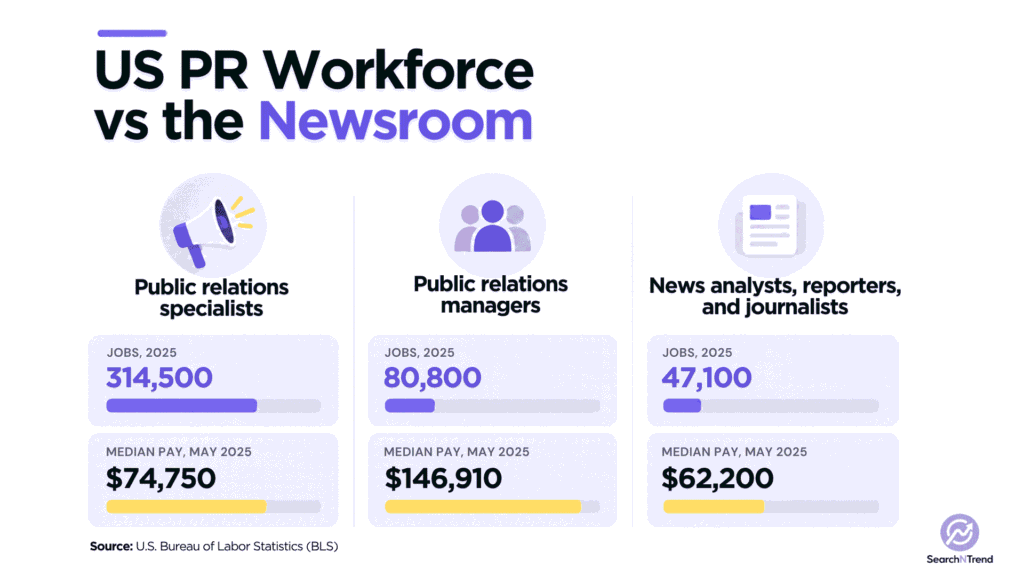
| Occupation (US) | Jobs, 2025 | Median pay, May 2025 | Projected change, 2025 to 2035 |
|---|---|---|---|
| Public relations specialists | 314,500 | $74,750 | +2% |
| Public relations managers | 80,800 | $146,910 | +6% |
| News analysts, reporters, and journalists | 47,100 | $62,200 | -6% |
Sources: BLS PR specialists, BLS PR managers, BLS journalists.
PR Agency Revenue in the US
The Census Bureau’s Service Annual Survey is the only official revenue series for US PR agencies (NAICS 54182). Its latest published year is 2022.
- $19.69 billion in revenue was earned by US PR agencies subject to federal income tax in 2022.
- 19%: PR agency revenue grew from $16.55 billion in 2021 to $19.69 billion in 2022, the largest one-year gain in the series since 2000.
- 4.3x: PR agency revenue in 2022 was about 4.3 times its 1998 level of $4.58 billion (nominal).

The table below highlights the PR agency revenue in the United States from 2018 to 2022.
| Year | US PR agency revenue (nominal) | Change vs prior year |
|---|---|---|
| 2018 | $13.81B | n/a |
| 2019 | $14.07B | +1.8% |
| 2020 | $14.54B | +3.3% |
| 2021 | $16.55B | +13.9% |
| 2022 | $19.69B | +19.0% |
Source: US Census Bureau. Year-over-year changes are SearchNTrend calculations.
Pitching and Journalist Relations Statistics
Journalists still depend on PR, but they say most pitches miss. PR teams, in turn, say reporters are harder to reach. The figures below come from separate surveys of each group, so they are presented in two parts.
What journalists say
- 66% of journalists rely on PR-provided content, such as press releases and pitches, for story ideas.
- 86% of journalists say at least some of their stories originate from PR pitches.
- 88% of journalists immediately disregard pitches that fall outside their beat.
- 78% of journalists say a pitch feels relevant when it directly affects their audience’s community.
- 42% of journalists are looking for access to verified subject matter experts from PR.
- 49% of journalists name resource constraints, such as shrinking budgets and staff cuts, as their biggest obstacle, up from 29% a year earlier.
- 53% of journalists oppose AI-generated pitches.
- 82% of journalists use at least one AI tool, up from 77% the year before.
Source: Muck Rack, Cision, PR Newswire
What PR professionals say
- 61% of PR professionals say media lists in their relevant beats are shrinking.
- 49% of PR professionals pitch more than 20 journalists per campaign or announcement.
- 66% of PR professionals usually or always personalize pitches, down from 70% the previous year.
- 80% of PR professionals use generative AI in their work.
- 60% of PR professionals say LinkedIn is the most valuable social platform for their work, far ahead of Instagram at 18%.
Source: Muck Rack
Digital PR and AI Search Visibility Statistics
AI assistants and AI search features now decide which sources many people see. The evidence shows these systems lean heavily on earned media, while clicks to websites fall.
How AI systems choose sources
- 27% of all links cited by ChatGPT, Claude, and Gemini in May 2026 pointed to journalism.
- More than half of journalism citations in AI answers come from articles published within the previous 12 months.
- 20,000+ distinct news outlets were cited in AI answers, so citations are not limited to national brands.
- 0.664 vs 0.266: Branded web mentions correlated far more strongly with brand visibility in ChatGPT than Domain Rating did, across about 75,000 brands.
Source: Ahrefs, Muck Rack
How AI search affects clicks
- 1% of Google visits with an AI summary led to a click on a link inside the summary itself.
- 35% higher: Organic click-through rate was 0.70% when a brand was cited in a Google AI Overview vs 0.52% when it was not (Q3 2025).
- 61%: Organic click-through rate on queries that showed an AI Overview fell from 1.76% to 0.61% between June 2024 and September 2025.
- 1 billion+: Google’s AI Mode passed 1 billion monthly active users by July 2026.
Source: Google, Pew Research Center, Seer Interactive
How audiences and PR teams are responding
- 49% of US adults say they use AI chatbots, up from 33% in 2024; 42% use them to search for information.
- 60% of US adults say they read the AI summaries at the top of search results.
- 42% of people who use AI chatbots for news say they always or often click through to the original sources, compared with 44% for search and 36% for social media (global).
- 29% of PR professionals say no one at their organization owns GEO.
- 55% of PR professionals pursue coverage in high-authority publications as a tactic to improve AI visibility, the most common approach.
Source: Muck Rack, Reuters Institute, Pew Research Center
Digital PR Budget and Cost Benchmarks
No independent or official source tracks digital PR budgets or cost per link. The figures below come from one vendor survey of about 150 practitioners, so treat them as directional.
- About 60% of digital PR teams report a monthly budget under $10,000.
- 8.8% of teams report monthly budgets above $20,000, up from 4% a year earlier.
- $300 to $500 is the most commonly reported cost per earned link (19.6% of respondents).
- 39.2% of practitioners do not know their cost per link, down from 51.4%.
Source: BuzzStream
Media Trust Statistics
Earned media’s value depends on audience trust in the outlets that carry it. Gallup and the Reuters Institute measure trust with different questions, so their figures should not be compared directly.
- 33% of Americans have a great deal or fair amount of trust in the mass media, up from a record low of 28% in 2025.
- 50% vs 22%: Democrats are more than twice as likely as Republicans to trust the mass media; independents sit at 31%.
- 25% of Americans say they trust most news most of the time, down 5 points and the lowest US score since 2015.
- 20% of people globally trust answers from AI chatbots, compared with 37% for news overall.
Source: Reuters Institute, Gallup
Original Analysis: The Pitch Squeeze
SearchNTrend combined BLS employment data with survey results to measure how the balance between PR and newsrooms is shifting.
PR-to-journalist ratio. Using BLS job counts for 2025, there are 6.7 PR specialists per journalist (314,500 ÷ 47,100). Adding PR managers raises the ratio to 8.4 (395,300 ÷ 47,100). If BLS projections hold, the specialist-only ratio rises to 7.2 by 2035 (320,200 ÷ 44,300).
Pay gap. The median PR specialist earned $12,550 more than the median journalist in May 2025, a 20% premium ($74,750 vs $62,200).
Agency revenue growth. US PR agency revenue grew at a compound annual rate of about 9.3% from 2018 to 2022, and by 35% from 2020 to 2022 alone (nominal dollars).
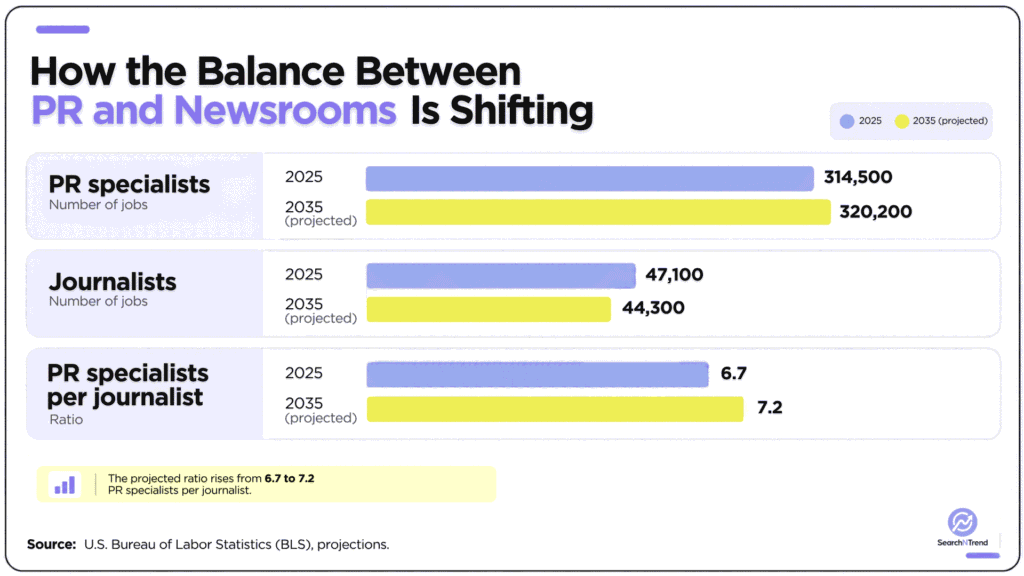
| Measure | 2025 | 2035 (projected) | Change |
|---|---|---|---|
| PR specialists | 314,500 | 320,200 | +5,700 |
| Journalists | 47,100 | 44,300 | -2,800 |
| PR specialists per journalist | 6.7 | 7.2 | +0.5 |
Source: BLS PR specialists and BLS journalists. Ratios and 2035 counts are SearchNTrend calculations from BLS projections.
What it means. More PR people are competing for fewer reporters. That fits what both sides report: 71% of PR pros struggle with response rates, while 72% of journalists say fewer than a quarter of pitches are relevant. These surveys used different samples, so they show a consistent pattern rather than a measured link. In AI search, the evidence points the same way: earned media dominates AI citations, and brands cited in AI Overviews saw higher click-through than uncited ones, though these studies show correlation, not cause.
Read our other reports:
Methodology
This report draws on three types of evidence:
- Official US data. BLS Occupational Outlook Handbook figures use May 2025 wage data and 2025 to 2035 employment projections. BLS job counts come from the projections program and include self-employed workers, so they differ from payroll-only OEWS counts. Census revenue covers PR agencies (NAICS 54182) subject to federal income tax, in nominal dollars; 2022 is the latest published year.
- Independent research. Pew Research Center and Gallup use probability-based US samples. The Reuters Institute uses online panels across 48 markets; global and US figures are labeled.
- Vendor surveys and datasets. Cision (1,899 journalists, 19 markets, January to February 2026), Muck Rack State of Journalism (897 journalists, mostly US, January to March 2026), Muck Rack State of PR (971 PR professionals, 91% US, May to June 2026), BuzzStream (about 150 practitioners, fieldwork dates not stated), Muck Rack Generative Pulse (25 million+ cited links), Ahrefs (about 75,000 brands), and Seer Interactive (3,119 queries from 42 client organizations). These are opt-in or platform-based and not statistically representative. Several publishers sell PR, SEO, or AI visibility tools.
Ratios, growth rates, and pay gaps marked “SearchNTrend calculation” were computed from the cited figures. Competitor statistics roundups were reviewed to find coverage gaps but were not used as sources.
Conclusion
Digital PR in 2026 is working with more practitioners, fewer reporters, and a new audience in AI systems. US PR specialists outnumber journalists about 6.7 to 1, 72% of journalists say fewer than a quarter of the pitches they get are relevant, and 71% of PR pros name low response rates as a top challenge. At the same time, earned media made up 84% of AI citations in Muck Rack’s May 2026 sample, while 39% of PR professionals still don’t measure their AI visibility.
For PR teams, the evidence points to relevance over volume: 88% of journalists ignore pitches outside their beat, and nearly half of PR pros pitch more than 20 journalists per campaign. It also makes AI visibility worth tracking, because brands cited in Google AI Overviews saw higher click-through than uncited ones, though that link is a correlation, not proof of cause. Three things are worth watching: whether BLS employment data follows the projected 6% newsroom decline, how earned media’s share holds up in future Generative Pulse editions, and whether Census publishes PR agency revenue beyond 2022.
Digital PR FAQs
Digital PR is the practice of earning coverage, mentions, and links from online publications, usually through data-led stories, expert commentary, and press outreach. It overlaps with SEO because earned coverage can build links and, increasingly, visibility in AI answers.
The evidence suggests it matters. Earned media made up 84% of AI citations in Muck Rack’s May 2026 analysis, and Ahrefs found branded web mentions correlate more strongly with AI visibility than link metrics do. Neither study proves causation.
About 6.7 PR specialists per journalist in 2025, based on BLS job counts of 314,500 and 47,100. Including PR managers, the ratio is about 8.4.
Mostly relevance. 88% disregard pitches outside their beat, and 72% say fewer than a quarter of the pitches they receive are relevant.
The median annual pay for PR specialists was $74,750 in May 2025. PR managers earned a median of $146,910.
There is no official benchmark. In BuzzStream’s 2026 practitioner survey, about 60% of teams spend under $10,000 a month, and the most common cost per link is $300 to $500.