



The share of US teens who used ChatGPT for schoolwork doubled from 13% in 2023 to 26% in 2024. Teachers are moving just as fast: 60% of US public K-12 teachers used AI tools for their work in the 2024-25 school year. Rules have not kept pace. Furthermore, only 18% of teachers had received formal guidance on AI from their administrators by spring 2026.
This report covers AI use among K-12 students, college students, teachers, and faculty, plus school policies, training, academic integrity, learning outcomes, federal and state policy, and market size. It draws on national surveys from Pew Research Center, Gallup, RAND, the Center for Democracy and Technology, College Board, and Common Sense Media, along with two randomized trials, government documents, and AI company disclosures.
Please find details of the sources in our methodology section at the bottom of this content.
Key AI in Education Statistics 2026
- 26% of US teens ages 13 to 17 used ChatGPT for schoolwork in fall 2024, double the 13% in 2023.
- 54% of US teens use AI chatbots to get help with schoolwork, and 10% use them for all or most of their schoolwork (fall 2025).
- 60% of US public K-12 teachers used AI tools for their work in 2024-25. Teachers who use AI weekly estimate it saves them 5.9 hours a week.
- 18% of US public K-12 teachers have received formal guidance from administrators on using AI for at least one work task (spring 2026).
- 48% of US school districts had trained teachers on AI by fall 2024, up from 23% in fall 2023.
- 85% of US college students used generative AI for coursework in the past year (July 2025).
- 95% of US college faculty expect generative AI to increase students’ overreliance on AI (fall 2025, non-scientific survey).
- 35 states have published state education agency guidance on AI (April 2026).
How Many Students Use AI for School?
Every major survey finds that a majority of US students now use AI in some form, but the exact figure depends heavily on who is asked and how “use” is defined.
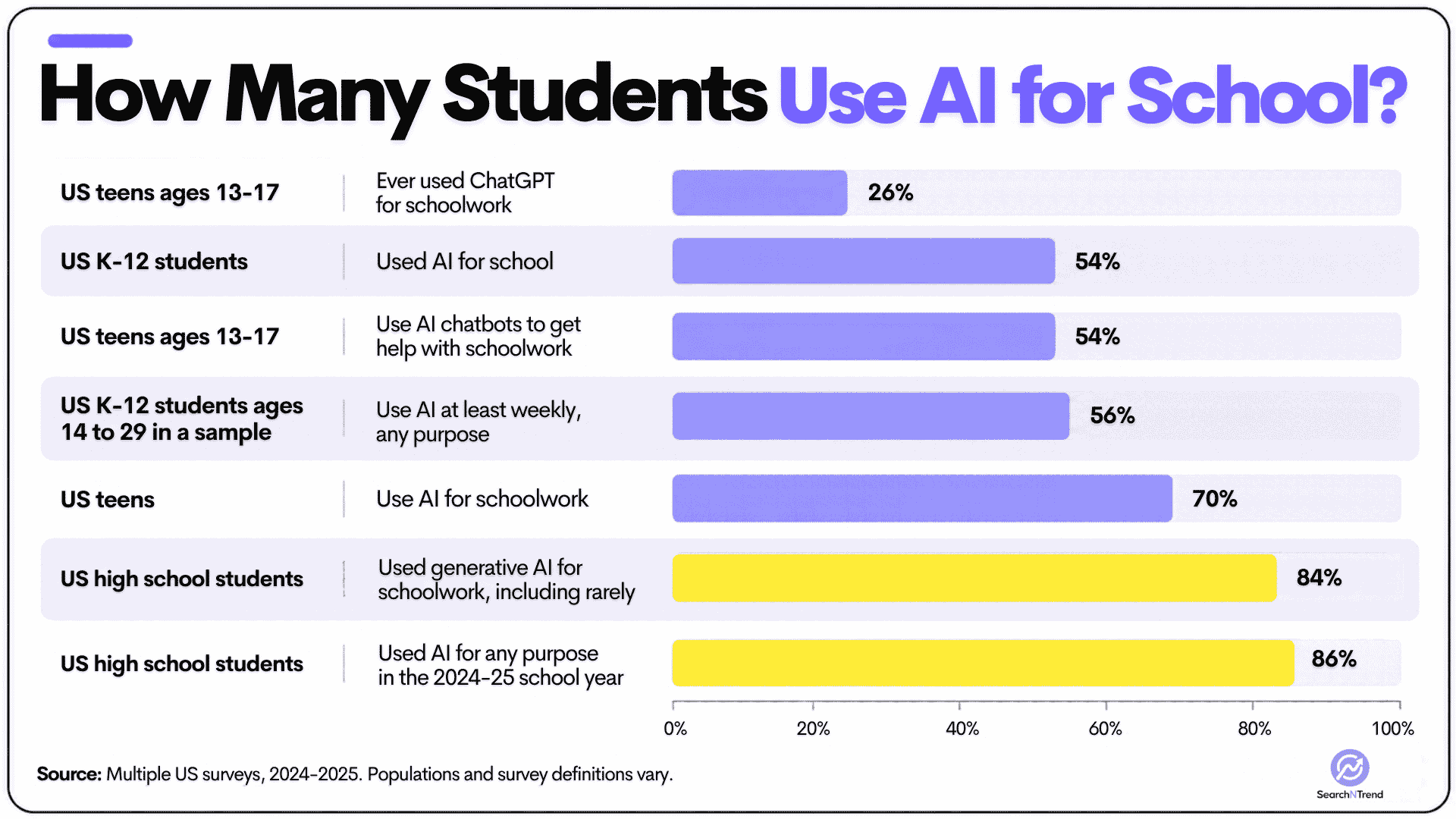
The table below sets the main national estimates side by side.
| Who was surveyed | What was measured | Result |
|---|---|---|
| US teens 13 to 17 | Ever used ChatGPT for schoolwork | 26% |
| US K-12 students | Used AI for school | 54% |
| US teens 13 to 17 | Use AI chatbots to get help with schoolwork | 54% |
| US K-12 students in a sample of ages 14 to 29 | Use AI at least weekly, any purpose | 56% |
| US teens | Use AI for schoolwork | 70% |
| US high school students | Used generative AI for schoolwork, including rarely | 84% |
| US high school students | Used AI for any purpose in the 2024-25 school year | 86% |
K-12 Students AI Usage in Education
- 26% of US teens used ChatGPT for schoolwork in fall 2024, up from 13% in 2023. Use was highest among 11th and 12th graders (31%).
- 31% of Black teens and 31% of Hispanic teens used ChatGPT for schoolwork in 2024, compared with 22% of White teens.
- 64% of US teens use AI chatbots for any purpose, and 54% use them for help with schoolwork (fall 2025).
- 54% of US K-12 students reported using AI for school in 2025, more than 15 percentage points higher than one to two years earlier.
- 84% of US high school students had used generative AI for schoolwork by May 2025, up from 79% in January 2025. The share using it often or sometimes was lower, at 52% to 61%.
- 70% of US teens use AI for schoolwork (2026).
- 56% of US K-12 students (ages 14 and older) use AI at least weekly, including 23% who use it daily (early 2026).
AI in Education Among College Students
- 85% of US college students used generative AI for coursework in the past year, including 86% at four-year colleges and 79% at community colleges (July 2025).
- More than one-third of US adults ages 18 to 24 use ChatGPT, and over a quarter of their messages relate to learning, tutoring, or schoolwork (January 2025 platform data).
Sources: Pew Research Center, RAND, College Board, Common Sense Media, Gallup, Inside Higher Ed, OpenAI
How Students Use AI
Students use AI most often to find information, brainstorm, and get explanations, but a meaningful minority hand in AI output with little change. The figures below come from separate surveys, so their categories are not directly comparable.
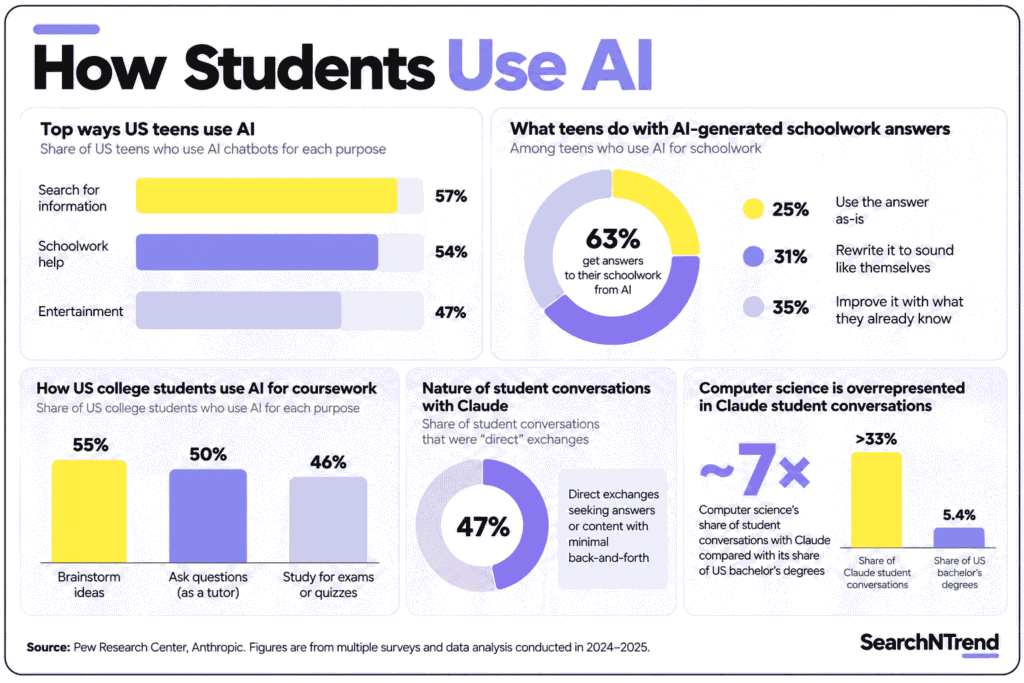
- 57% of US teens use AI chatbots to search for information, the most common use, ahead of schoolwork help (54%) and entertainment (47%).
- 63% of teens who use AI for schoolwork say they get answers to their schoolwork from AI. Among them, 25% use the answer as-is, 31% rewrite it to sound like themselves, and 35% improve it with what they already know.
- 55% of US college students who use AI for coursework use it to brainstorm ideas, 50% to ask questions as they would a tutor, and 46% to study for exams or quizzes.
- 47% of student conversations with Anthropic’s Claude were “direct” exchanges seeking answers or content with minimal back-and-forth, based on 574,740 conversations from accounts tied to university email addresses.
- About 7 times: computer science’s share of student conversations with Claude (more than a third) compared with its 5.4% share of US bachelor’s degrees.
Sources: Pew Research Center, Common Sense Media, Anthropic, Inside Higher Ed
AI Use Among Teachers and Faculty
Teacher adoption has grown quickly, led by lesson preparation and materials. Most of the time-savings evidence is self-reported.
K-12 Teachers
- 60% of US public K-12 teachers used an AI tool for their work in 2024-25, and 32% used one at least weekly.
- 5.9 hours a week is the average time teachers who use AI weekly estimate it saves them, which Gallup equates to about six weeks over a school year.
- 57% to 74% of teachers who use AI say it improves the quality of their work, depending on the task (lowest for grading and feedback, highest for administrative work).
- 85% of US grades 6 to 12 public school teachers used AI during the 2024-25 school year.
- 53% of US English, math, and science teachers used AI for school in 2025, up more than 15 percentage points from one to two years earlier.
Sources: Walton Family Foundation-Gallup, Center for Democracy and Technology, RAND
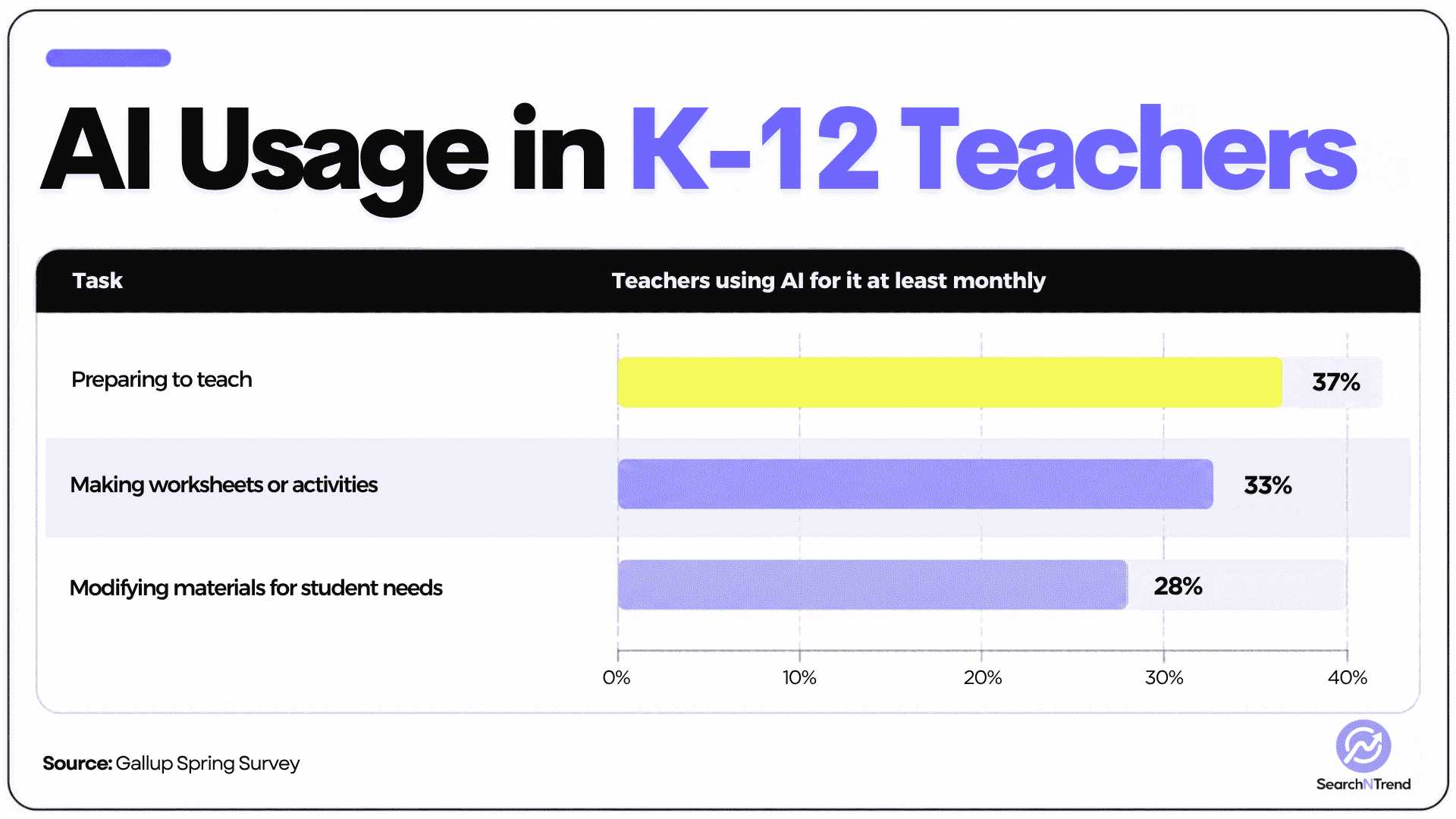
The most common teacher uses of AI, per Gallup’s spring 2025 survey:
| Task | Teachers using AI for it at least monthly |
|---|---|
| Preparing to teach | 37% |
| Making worksheets or activities | 33% |
| Modifying materials for student needs | 28% |
College Faculty
- 47% of US college faculty have redesigned their assessments in response to AI (2026).
- 69% of US college faculty address AI literacy topics such as bias, hallucinations, privacy, or ethics in their teaching (fall 2025, non-scientific survey).
- 68% of faculty say their institution has not adequately prepared them to use generative AI for teaching or mentoring.
Sources: Elon University and AAC&U, Tyton Partners
School AI Policies, Guidance, and Training
Schools are writing rules and training staff, but coverage is still partial and uneven by district wealth.
K-12 Policies and Guidance
- 45% of US principals reported having school or district policies or guidance on AI use in 2025, and 34% of teachers reported AI policies on academic integrity.
- 18% of teachers have formal administrator guidance on AI, 48% have only informal guidance, and 34% have none (spring 2026).
- 69% of teachers have no guidance at all on using AI for one-on-one tutoring, and 58% have none on grading and feedback.
- 74% of US K-12 students say their school has rules on AI use (2026), up from 51% in 2025.
- About 2 in 5 US high schools or districts do not allow student use of generative AI, while about 13% encourage it in all classes (2025).
- 59% of teens who use AI for schoolwork and have had an AI tool blocked at school switched to a personal device to get around the block.
Sources: Common Sense Media, RAND, College Board, Gallup, Walton Family Foundation-Gallup
K-12 Training
- More than 80% of US K-12 students say their teachers have not explicitly taught them how to use AI for schoolwork (2025).
- 27% of US teens say a teacher has talked with them about using AI safely.
- 10% of US grades 6 to 12 teachers received training on how to respond to student AI use they suspect is harmful to well-being (2024-25).
Sources: Center for Democracy and Technology, RAND, Common Sense Media
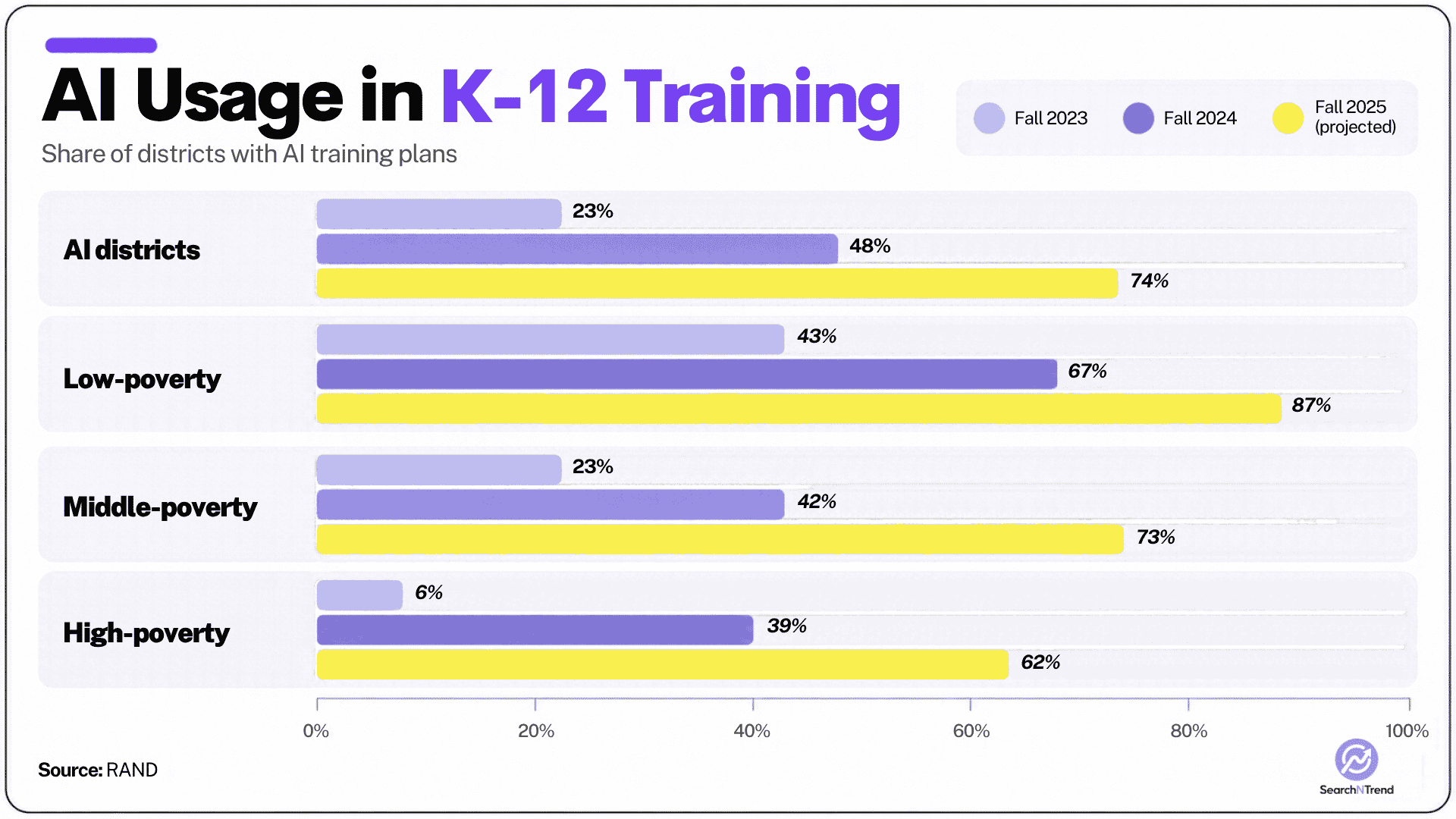
District teacher training on AI, by district poverty level:
| District type | Fall 2023 | Fall 2024 | Fall 2025 (projected from plans) |
|---|---|---|---|
| All districts | 23% | 48% | 74% |
| Low-poverty | 43% | 67% | 87% |
| Middle-poverty | 23% | 42% | 73% |
| High-poverty | 6% | 39% | 62% |
Source: RAND
Higher Education Policies
- 32% of US colleges and universities have a campus-wide AI policy, and 23% of faculty consider their institution’s AI policies effective (2026).
- 87% of US faculty have set explicit AI policies for their own courses, but 48% say their institution has clear campus-wide guidelines (fall 2025, non-scientific survey).
Sources: Elon University and AAC&U, Tyton Partners
You can also check out our detailed report on AI in eCommerce to know more about how the shopping experience is shifting with the rise of AI.
Cheating, Academic Integrity, and Critical Thinking
Concern about cheating and weaker thinking skills is widespread among students, parents, and faculty. These figures are perceptions, not measured rates of misconduct.
What Students and Parents Say
- 59% of US teens say students at their school use AI to cheat at least somewhat often, and about a third say it happens extremely or very often (fall 2025).
- Half of US K-12 students worry about being falsely accused of using AI to cheat (2025).
- 61% of US parents, 55% of high school students, and 22% of district leaders agree that greater AI use will harm students’ critical-thinking skills (2025).
- 39% of US teens who use AI for schoolwork feel they miss out on learning when they use it to complete assignments.
- 50% of US high school students agree that using AI in class makes them feel less connected to their teacher (2024-25).
Sources: Center for Democracy and Technology, RAND, Pew Research Center, Common Sense Media
What Faculty Say
- 78% of US college faculty say cheating has increased since generative AI became widely available, and 73% have personally dealt with an AI-related academic integrity issue (fall 2025, non-scientific survey).
- 90% of faculty expect generative AI to reduce students’ critical-thinking skills, and 83% expect shorter attention spans.
Source: Elon University and AAC&U
Does AI Improve Learning? What Experiments Show
Many claims about AI raising test scores come from vendor case studies. Randomized controlled trials, which compare similar students with and without AI, are still rare. Two recent trials found sizable gains from AI tutors built with guardrails, but both were small or limited in scope.
- More than double: Harvard introductory physics students learned more than twice as much from a custom AI tutor as from an in-class active-learning lesson on the same material, with an estimated effect of 0.63 standard deviations. The trial covered 194 students and two lessons in fall 2023.
- 49 minutes: the median time students spent with the AI tutor, compared with a 60-minute class session.
- 0.31 standard deviations: the overall gain from a six-week program in Nigeria in which secondary students used a GPT-4 tutor for English. The World Bank authors equate it to about 1.5 to 2 years of typical schooling.
- 27% of US college students who use AI for coursework say it has had a positive effect on their learning, 55% say the effect is mixed, and 7% say it is negative.
Source: Kestin et al., Scientific Reports, Inside Higher Ed, World Bank
Attitudes Toward AI in Education
Young people are using AI as much as before but feel less positive about it. Faculty are notably pessimistic.
- 36% of US teens expect AI to have a positive effect on their own lives over the next 20 years, and 15% expect a negative one.
- 80% of US Gen Z respondents (ages 14 to 29) say it is very or somewhat likely that AI will make learning harder in the future (early 2026).
- 46% of Gen Z respondents agree AI helps them learn faster, down from 53% in 2025.
- 62% of US college faculty expect student learning outcomes to get worse over the next five years because of generative AI (fall 2025, non-scientific survey).

The table below shows Gen Z feels about AI, 2025 vs 2026:
| Emotion | 2025 | 2026 | Change (points) |
|---|---|---|---|
| Excited | 36% | 22% | -14 |
| Hopeful | 27% | 18% | -9 |
| Angry | 22% | 31% | +9 |
| Anxious | 41% | 42% | +1 |
Source: Gallup. Change column is a SearchNTrend calculation.
AI in Education Policy: Federal and State
Federal policy since 2025 has encouraged AI adoption in schools through grants and guidance, while most rules are set by states and districts.
- April 23, 2025: Executive Order 14277 created a White House Task Force on AI Education and a Presidential AI Challenge, and directed agencies to prioritize AI in teacher-training grants.
- July 2025: The US Department of Education told schools that existing federal formula and discretionary grant funds may be used for AI-based instructional materials, AI-enhanced tutoring, and college and career advising.
- May 13, 2026: The Department’s final supplemental grant priority on “Advancing Artificial Intelligence in Education” took effect, covering AI literacy, K-12 AI and computer science education, educator training, and AI tutoring.
- 35 states had published state education agency guidance on AI as of April 2026.
- 1 state, Utah, had enacted an AI literacy requirement for K-12 students as of May 2026.
Source: ExcelinEd, The White House, Federal Register, Education Commission of the States, US Department of Education
AI in Education Market Size
Approximately, the AI in education market size is estimated to be around $9.58 billion to $11.4 billion as of 2026.
It’s important to note that the market sizes come from private research firms, and their estimates differ. We show two side by side rather than presenting either as a fact.
| Estimate | 2026 global market | Forecast | Growth rate |
|---|---|---|---|
| Grand View Research | $11.4 billion | $57.2 billion by 2033 | 25.9% a year (2026-2033) |
| Precedence Research | $9.58 billion | $136.79 billion by 2035 | 34.52% a year (2026-2035) |
Sources: Grand View Research
- 37.5% of the global AI in education market’s 2025 revenue came from North America, the largest region, according to one estimate.
Original Analysis on AI in Education By SearchNTrend
The calculations below are SearchNTrend’s own, based on the figures cited above.
Why Student AI-Use Estimates Range From 26% to 86%
Published figures on student AI use vary by a factor of more than three. The surveys do not contradict each other; they measure different things. Pew’s 26% (fall 2024) counts ChatGPT only, while Pew’s 54% a year later counts any AI chatbot. CDT’s 86% includes AI use for any reason, while most other surveys count schoolwork only. College Board’s 84% includes students who use AI “rarely,” and its often-or-sometimes share is 52% to 61%. RAND’s 54% includes middle school students, who use AI less than high school students. All of these figures are cited with sources in the student usage section above.
For a general figure on US teens using AI for schoolwork, Pew’s 54% (fall 2025) is the most conservative estimate from a probability-based sample. Figures above 80% describe any use, including occasional use, among high school students.
The Use-to-Guidance Gap
In spring 2025, 60% of US public K-12 teachers used AI. A year later, 18% had received formal administrator guidance on any AI task. These are two separate Gallup samples a year apart, so we show them side by side rather than as a single ratio. Even so, most teachers using AI are doing it without formal direction from their schools.
Students saw faster change. The share of K-12 students reporting school AI rules rose 23 points in one year (51% to 74%), and access to AI tools on school computers rose 13 points (36% to 49%), per Gallup.
Teacher Time Savings in Hours
Gallup’s 5.9 hours a week, multiplied by its 37.4-week school year, equals about 221 hours a year (5.9 × 37.4 = 220.7). That is about 5.5 standard 40-hour work weeks. Gallup rounds this to “six weeks.” The figure applies only to weekly AI users (32% of teachers) and is self-reported.
District Training and the Poverty Gap
The share of districts training teachers on AI more than doubled in one year, from 23% to 48% (+25 points). The gap between low-poverty and high-poverty districts narrowed from 37 points in fall 2023 (43% vs 6%) to 28 points in fall 2024 (67% vs 39%). Based on district plans, RAND projected a 25-point gap in fall 2025 (87% vs 62%). High-poverty districts improved fastest but still trail.
Methodology
This report combines national surveys, platform data, experiments, and policy documents published between January 2025 and October 2026. We cited original reports and verified each figure against its source page. Survey periods and sample sizes:
- Pew Research Center: US teens 13 to 17, Ipsos KnowledgePanel. 2024 survey: 1,391 teens, Sept. 18 to Oct. 10, 2024. 2025 survey: 1,458 teens and parents, Sept. 25 to Oct. 9, 2025, margin of error ±3.3 points.
- Walton Family Foundation-Gallup: US public K-12 teachers from the RAND American Teacher Panel. 2,232 teachers (March 18 to April 11, 2025) and 2,069 teachers (Feb. 9 to March 2, 2026), each with a margin of error of ±2.5 points.
- Gallup Gen Z: 1,572 respondents ages 14 to 29, Feb. 24 to March 4, 2026. K-12 student margin of error ±5.4 points.
- RAND: Nationally representative survey panels of students, teachers, principals, district leaders, and parents (2025), and the American School District Panel (fall 2023 and fall 2024).
- Center for Democracy and Technology: 1,030 high school students, 806 grades 6 to 12 teachers, and 1,018 parents, 2024-25 school year.
- College Board: about 600 high school students per wave, January to May 2025. Data are unweighted.
- Common Sense Media: more than 1,000 US teens, published August 2026.
- Inside Higher Ed and Generation Lab: 1,047 students at 166 institutions, July 2025.
- Elon University and AAC&U: 1,057 faculty, Oct. 29 to Nov. 26, 2025. The organizers describe it as non-scientific, so results are not generalizable to all faculty.
- Tyton Partners: 3,300+ students, instructors, and administrators at 850+ US institutions (2026). Vendor research.
Limitations. No federal statistical agency publishes a national series on AI use in schools, so these surveys are the best available evidence. Time savings and learning benefits reported in surveys are perceptions, not measured outcomes. OpenAI and Anthropic figures are company platform data. The two randomized trials are small or non-US and should not be generalized to all students. Market sizes are proprietary estimates. Year-over-year comparisons are made only within the same survey series.
Other statistics to check out:
Conclusion
AI has become a routine part of US schooling since 2023. Teen ChatGPT use for schoolwork doubled to 26% in 2024, and by fall 2025, 54% of teens used AI chatbots for schoolwork. Sixty percent of teachers used AI in 2024-25, and district training more than doubled to 48%. Guidance has lagged: only 18% of teachers had formal administrator guidance in 2026, and high-poverty districts still trail low-poverty ones on training.
For educators and policymakers, the clearest gaps in the data are guidance and training rather than adoption. Three things are worth watching: whether 2025-26 district data confirm RAND’s projected 74% training rate, whether federal grants under the May 2026 AI priority reach high-poverty districts, and whether larger trials replicate the early tutoring gains in US classrooms.
FAQs
It depends on the definition. In fall 2025, 54% of US teens said they use AI chatbots for schoolwork. Broader measures that include any or occasional use reach 84% to 86% of high school students. Among college students, 85% used AI for coursework in the past year.
60% of US public K-12 teachers used AI tools for their work in 2024-25, and 32% used them weekly
Teachers who use AI weekly estimate it saves them 5.9 hours a week, about six weeks over a school year. The figure is self-reported.
Partly. In 2025, 45% of US principals reported school or district AI policies or guidance. By 2026, 74% of K-12 students said their school had AI rules, but only 18% of teachers had formal guidance from administrators.
Early experimental evidence is positive but limited. A Harvard trial found students learned more than twice as much with a custom AI tutor as in an active-learning class, and a World Bank trial in Nigeria found a 0.31 standard deviation gain after six weeks. Both involved structured tutors, not open-ended chatbot use.
35 states had published state education agency guidance on AI as of April 2026.