



Online shopping used to start with a Google search, a visit to Amazon, or a browse through a retailer’s website. That’s changing. Shoppers are increasingly asking AI tools to compare products, find deals, and narrow down their choices before they visit an online store.
Retailers are adapting, too. They’re using AI to write product descriptions, answer customer questions, personalize recommendations, and manage everyday operations. Some are also preparing for a different kind of shopping experience, where AI agents handle several steps of a purchase instead of simply suggesting what to buy.
The numbers show how quickly this is developing. This article covers the latest AI in ecommerce statistics for 2026, including consumer adoption, AI-driven traffic, personalization, customer service, agentic commerce, and the challenges retailers face when implementing these technologies.
AI in eCommerce Statistics 2026: At a Glance
AI is becoming part of the shopping journey, but adoption looks different for consumers and businesses. The following statistics cover both sides, from how people research products to how retailers are preparing for AI-powered commerce.
| AI in ecommerce statistic | Figure |
|---|---|
| U.S. retail website traffic from AI sources | Up 393% year over year |
| U.S. consumers who have used AI for online shopping | 39% |
| AI-referred traffic conversion advantage | 42% higher |
| Shoppers using AI-powered chat or virtual assistants | 38% |
| Businesses using AI-powered chat or virtual assistants to sell | 36% |
| Growth in agentic search as the first step in shopping | 200% year over year |
| Commerce organizations using agentic AI | 28% |
| Consumers using AI assistants to research products | 41% |
| Consumers using AI assistants to look for reviews | 33% |
| Consumers using AI assistants to search for deals | 31% |
Sources: Adobe, DHL, Salesforce, and NRF
These figures don’t measure the same thing. Adobe tracks actual website activity alongside consumer survey responses, while DHL and NRF use surveys to understand shopping behavior. Salesforce combines business surveys with shopping activity across commerce sites.
How Big Is the AI in eCommerce Market?
There isn’t one universally accepted figure for the size of the AI in ecommerce market. Research firms define it differently, depending on whether they include recommendation engines, generative AI software, predictive analytics, automation tools, and other technologies used by online retailers.
Market forecasts can help estimate where investment is heading, but they shouldn’t be confused with actual spending or revenue generated by AI-powered ecommerce.
For a useful market-size figure, check the original research report and its definition of the market before publishing a forecast. A number that includes all retail AI software, for example, isn’t directly comparable with one covering AI tools specifically built for online stores.
How Many Shoppers Use AI for Online Shopping?
Adobe’s 2026 research found that 39% of surveyed U.S. consumers had used AI for online shopping. Of those consumers, 85% said AI had improved their shopping experience.
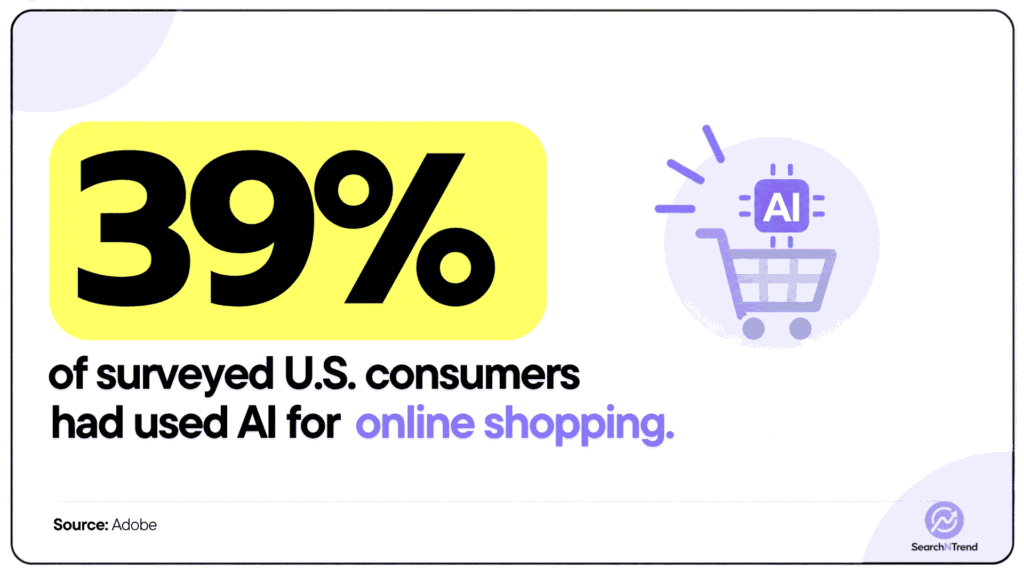
The figures come from Adobe’s consumer survey, rather than a count of transactions completed by AI. They suggest that shoppers are finding practical uses for these tools, particularly when researching products or trying to make a decision.
Source: Adobe.
What do consumers use AI for when shopping?
Product research is one of the clearest uses. Research from the National Retail Federation and IBM found that consumers were using AI assistants to research products, find reviews, and search for deals.
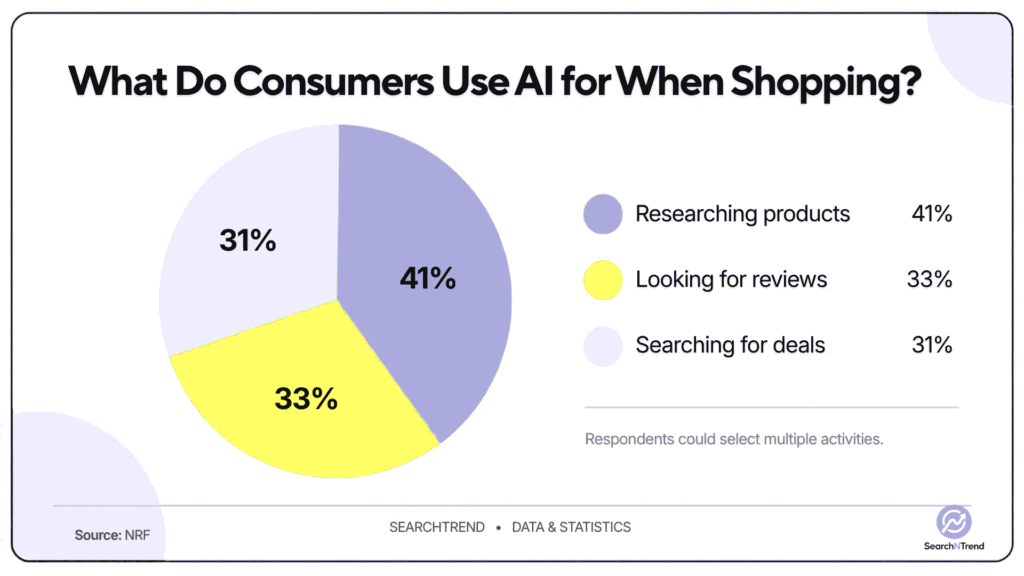
| Shopping activity | Share of consumers |
|---|---|
| Researching products | 41% |
| Looking for reviews | 33% |
| Searching for deals | 31% |
Source: NRF
These tasks are familiar parts of shopping, but AI gives consumers another way to handle them. Someone buying a laptop, for instance, can ask an assistant to compare battery life, performance, and price instead of opening several product pages and comparing specifications manually.
The figures also help explain why product information matters so much. If a retailer’s specifications are incomplete or inconsistent, an AI assistant may struggle to represent the product accurately.
AI Is Changing How Consumers Discover Products
A shopper no longer needs to begin with a search engine or retailer website. They might first ask an AI assistant which running shoes are suitable for flat feet, which laptop fits a particular budget, or where to find a product at the best price.
Salesforce reported that agentic search as the first step in a shopping journey grew 200% year over year in its 2026 State of Commerce research. Its analysis of shopping behavior also found that traffic referred from AI chats grew between 150% and 428% year over year in each quarter measured.
Source: Salesforce.
This shift creates a new challenge for online retailers: getting discovered before a customer reaches their website. Traditional search, marketplaces, and social media still matter, but AI assistants are becoming another route to product discovery.
AI traffic to ecommerce websites
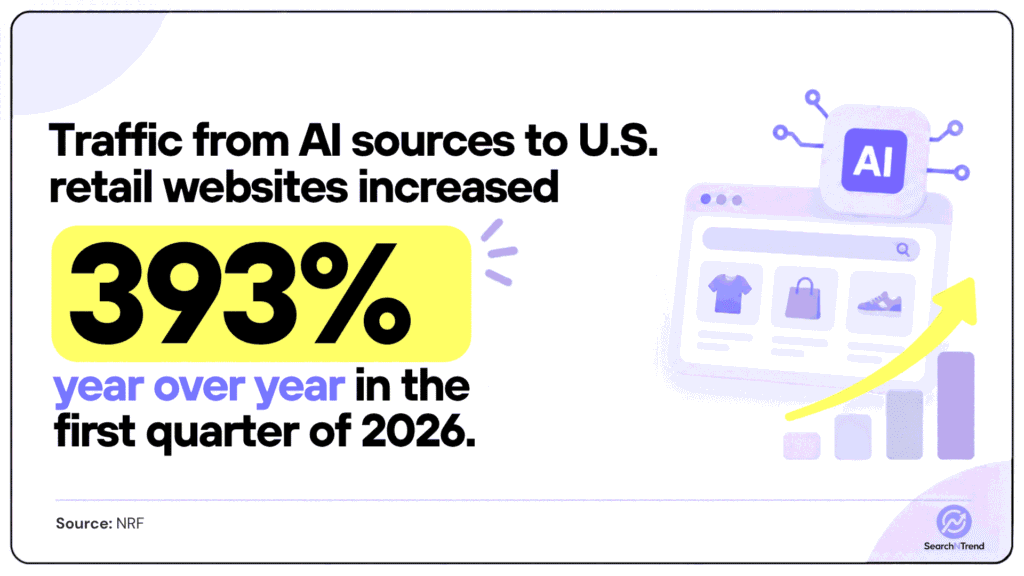
Adobe reported that traffic from AI sources to U.S. retail websites increased 393% year over year in the first quarter of 2026. Traffic was up 269% year over year in March alone.
These are increases in referral traffic, not in the number of consumers using AI. A shopper who clicks a product link from an AI conversation may generate a referral visit, while someone who researches a product with AI and later types the retailer’s URL directly may not.
Retailers should therefore track AI referrals separately in their analytics reports. The important questions are whether these visitors browse products, return to the site, add items to their carts, and complete purchases.
Do AI-referred shoppers convert better?
In March 2026, visitors arriving at U.S. retail websites from AI sources converted 42% better than visitors from non-AI sources, according to Adobe.
That’s a useful finding, but it needs context. It describes Adobe’s observed traffic during a specific period. It doesn’t mean that every visitor referred by ChatGPT or another AI tool is more likely to buy, or that installing an AI chatbot will automatically improve conversion rates.
The difference could also vary by product category, retailer, season, and the intent behind the AI conversation. Someone who clicks through after asking for a specific product may already be closer to making a purchase than someone casually browsing.
Source: Adobe
How Ecommerce Businesses Use AI
AI has applications across the entire ecommerce operation. Some are visible to customers, such as shopping assistants and personalized recommendations. Others work behind the scenes, helping teams manage product catalogs, forecast demand, detect fraud, and produce marketing content.
The best use case depends on the problem a retailer is trying to solve. A store with thousands of products may benefit from better product search, while a business receiving hundreds of repetitive support questions may get more value from customer service automation.
AI-powered product recommendations
Recommendation systems use information such as browsing history, previous purchases, product attributes, and customer preferences to suggest relevant items.
A clothing store could recommend products based on size, style, and previous purchases. An electronics retailer might suggest compatible accessories or compare products with similar specifications.
The quality of these recommendations depends on the data behind them. Outdated product information or incomplete attributes can lead to suggestions that don’t match what a customer needs.
Retailers should measure whether recommendations improve product clicks, conversions, average order value, and customer satisfaction. A recommendation that generates more clicks but also leads to more returns may not be helping the business.
AI for product descriptions and catalog management
Generative AI can help ecommerce teams draft product descriptions, summarize specifications, translate content, and organize large catalogs. It can also produce variations of marketing copy for different audiences.
This is particularly useful for stores with thousands of products and frequent catalog updates. But publishing AI-generated content without checking it can create problems. A model might invent a product feature, misstate a measurement, or describe an accessory as included when it isn’t.
Retailers should treat their product database as the source of truth. AI can help turn verified information into readable copy, but product specifications, pricing, compatibility, and availability still need to be accurate.
AI in ecommerce marketing
Marketing teams use AI to help with email campaigns, customer segmentation, ad creative, product messaging, and performance analysis. Generative AI can also help teams produce more content variations without starting every draft from scratch.
Adobe’s 2026 retail and consumer goods research found that 77% of surveyed brands reported moderate or significant improvements in the volume and speed of content ideation and production through generative AI.
That figure reflects reported improvements among surveyed brands, not an independently measured increase across the entire ecommerce industry.
The next step for marketing teams is to connect faster production with business results. More email variations or ad creatives are useful only if they improve engagement, conversion, or another meaningful metric.
AI for inventory and demand forecasting
Retailers can use AI to analyze historical sales, seasonality, promotions, pricing, and other demand signals when planning inventory. Better forecasts can help businesses decide what to order, when to replenish stock, and which products may be at risk of selling out.
Forecasting isn’t simply about keeping less inventory. A retailer must balance storage costs against missed sales, delayed deliveries, and excess stock. A model that reduces inventory but causes more stockouts could make the business worse off.
Useful measures include forecast accuracy, inventory turnover, stockout rates, sell-through, and carrying costs. Comparing those metrics before and after implementation gives retailers a more reliable picture of whether the system is working.
AI for fraud detection and returns
AI systems can flag unusual transaction patterns, potentially fraudulent purchases, and suspicious return activity. They help teams focus their attention on transactions that warrant further review.
The risk is that legitimate customers can also trigger a fraud alert. A retailer that blocks too many valid purchases may lose sales and damage customer trust.
Fraud prevention should therefore be evaluated alongside false-positive rates, manual review workload, customer complaints, and the value of prevented losses. A lower fraud rate is not a sufficient measure of success on its own.
AI Personalization in eCommerce
Personalization is one of the most established uses of AI in ecommerce. It can shape product recommendations, search results, promotional messages, and the content a shopper sees while browsing.
Adobe’s 2026 research found that 83% of surveyed brands expected highly personalized interactions that anticipate consumer needs in real time to define breakthrough customer experiences over the following two to three years.
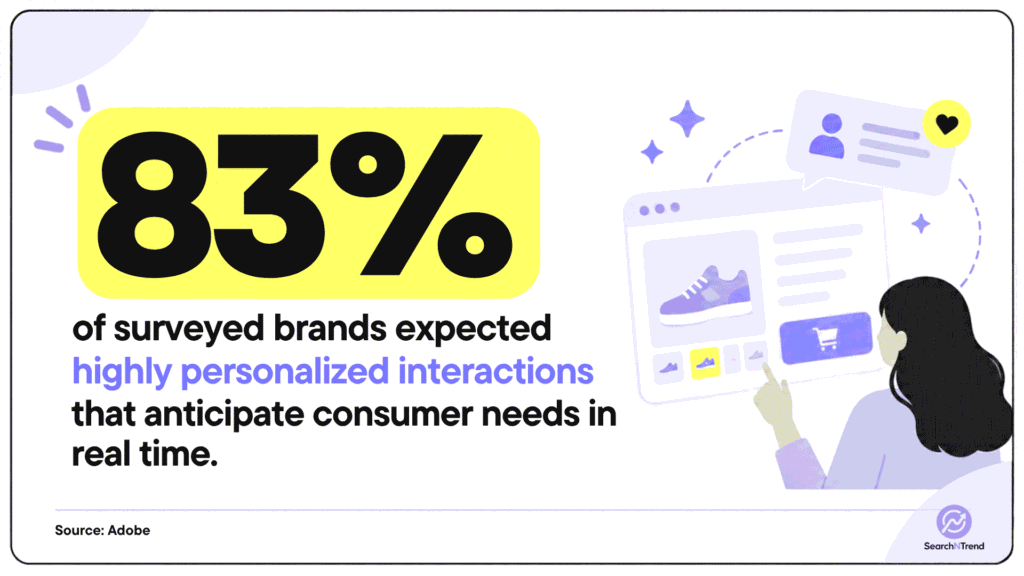
That number reflects what brands expect from future shopping experiences. It doesn’t mean 83% of retailers already deliver real-time personalization successfully.
Source: Adobe
Where AI personalization makes a difference
Retailers can use customer and product data to make shopping experiences more relevant. Common applications include:
- Product recommendations based on browsing or purchase history
- Search results tailored to a shopper’s needs
- Personalized email campaigns
- Relevant product bundles and complementary items
- Product suggestions based on stated preferences
- Targeted offers and promotions
The goal isn’t to personalize every interaction. It’s to help shoppers find what they want without making the experience feel intrusive.
Customer data and privacy concerns
Personalization requires data, and shoppers don’t always agree on how much information retailers should collect.
Research from NRF and IBM found that 52% of surveyed consumers were comfortable sharing their data, while 83% reported overlapping concerns about privacy, misuse, and unwanted marketing.
Source: NRF
Retailers need to be clear about how customer information is collected and used. They should also protect that data, avoid unnecessary collection, and provide appropriate controls. Personalized recommendations may help sell products, but they can undermine trust if customers feel that their privacy has been ignored.
AI Chatbots and Customer Service in eCommerce
AI chatbots can answer product questions, explain shipping policies, check order status, and handle other common support requests. More advanced systems can retrieve information from product catalogs, order management platforms, and help centers.
DHL’s 2026 Ecommerce Trends Report found that 38% of shoppers and 36% of businesses were using AI-powered chat or virtual assistants to buy and sell.
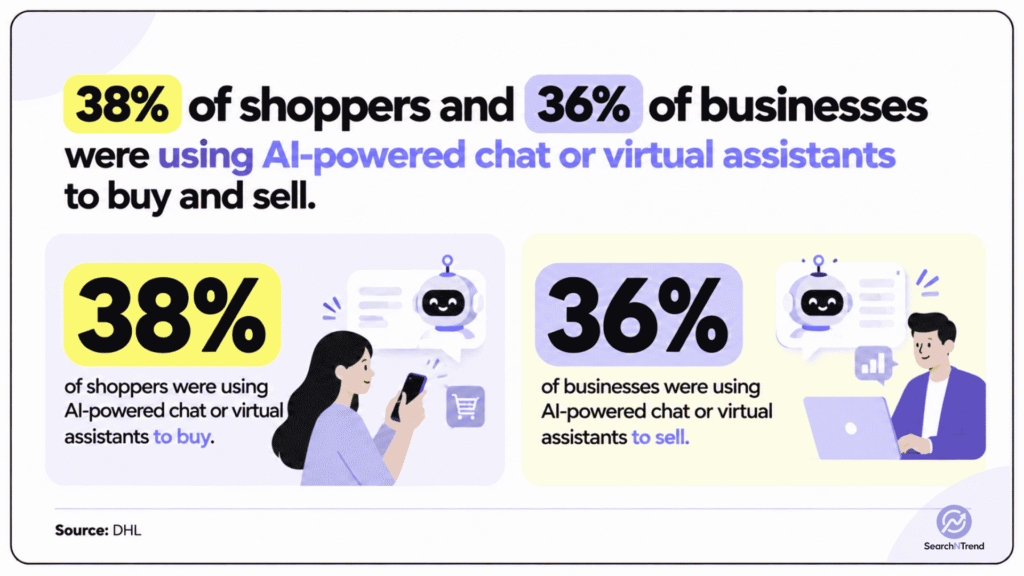
The survey covered 29,000 shoppers across 29 countries and 5,800 ecommerce businesses across 28 countries, making it a global finding rather than a U.S.-specific adoption rate.
Source: DHL
What can AI chatbots do for online retailers?
An ecommerce chatbot can help with product comparisons, order tracking, delivery questions, return policies, and basic troubleshooting. It can also direct customers to suitable products or pass more complicated issues to a human support agent.
The important part is how the chatbot handles information it doesn’t know. If a delivery date isn’t available, it should not invent one. If a question requires a decision outside its permissions, it should escalate the conversation rather than give a confident but incorrect answer.
How to measure chatbot performance
The number of conversations handled by a chatbot doesn’t tell a retailer whether customers are getting good support.
More useful measures include first-contact resolution, customer satisfaction, average resolution time, escalation rate, cost per resolved query, and the rate of incorrect answers. Conversion rate can be relevant for shopping assistants, but it shouldn’t be the only metric used to judge customer service.
What Is Agentic Commerce?
Agentic commerce refers to shopping experiences in which AI agents carry out several steps toward a purchase. Depending on the system, that might include researching products, comparing prices, checking availability, selecting an item, or preparing a cart for approval.
A standard chatbot may answer a question about running shoes. An AI agent could go further by comparing several models against a shopper’s budget, preferred brand, and running needs, then presenting a shortlist.
How far these systems can go varies. Researching a product is not the same as placing an order, and an agent that can complete a transaction needs clear permissions and reliable access to product, payment, and delivery information.
How many ecommerce businesses use agentic AI?
Salesforce reported that 28% of commerce organizations were using agentic AI in 2026, while another 52% planned to adopt it within the following six months.
The findings come from Salesforce’s research involving 3,450 commerce professionals across 20 countries and 13 industries. The company also analyzed shopping behavior from more than 1.5 billion global shoppers.
Source: Salesforce
The adoption figures need to be read carefully. Using agentic AI doesn’t necessarily mean a retailer has an autonomous checkout system. Some businesses may use agents for research, service, or internal workflows rather than allowing them to make purchases.
What retailers need before adopting agentic commerce
AI agents need accurate information to make useful recommendations. Retailers should keep product specifications, pricing, stock availability, shipping terms, and return policies consistent across their systems.
They also need to decide which actions an agent can take without approval. A shopper may be comfortable letting an assistant compare products but want to confirm the final item, price, and delivery address before paying.
Clear permissions and a way to review or reverse actions will matter as these systems become more capable.
AI and Ecommerce SEO: Product Discovery Beyond Traditional Search
AI assistants are giving shoppers another way to find products. Someone might ask ChatGPT for the best budget headphones and click through to a retailer from the response instead of starting with a conventional search results page.
This doesn’t make SEO obsolete. Search engines, marketplaces, social platforms, and direct traffic remain important discovery channels. Retailers now have another source of referrals to understand.
How ecommerce websites can prepare for AI search
Start with the information a shopper needs to make a decision. Product pages should have accurate titles, descriptions, specifications, prices, availability, shipping information, and return policies.
Other useful practices include:
- Keep product and category pages accessible to search crawlers.
- Use valid structured data where appropriate.
- Maintain consistent product information across feeds and pages.
- Link related products and categories logically.
- Write descriptions that answer real customer questions.
- Update pages when prices, stock, or product specifications change.
These practices help make product information clearer and more reliable. They don’t guarantee that an AI assistant will cite or recommend a particular retailer.
Measuring AI-driven traffic
Retailers should monitor visits from identifiable AI sources in their analytics tools. Sessions, engagement, conversion rate, revenue per visit, and assisted conversions can help show whether this traffic contributes to sales.
Referral data won’t capture every AI-assisted purchase. A shopper might discover a product in an AI conversation, leave, and return to the store later through a direct visit. The final session may not show where the journey began.
For that reason, AI referral traffic is a useful metric, but it isn’t a complete measure of AI’s influence on ecommerce sales.
Benefits and Risks of AI in eCommerce
AI can make certain shopping and operational tasks faster, but the outcome depends on how a system is implemented and what data it uses.
| Application | Potential benefit | Main concern |
|---|---|---|
| Product recommendations | Helps shoppers find relevant items | Irrelevant suggestions |
| Product content generation | Speeds up catalog updates | Incorrect specifications or claims |
| Customer service | Handles routine questions quickly | Inaccurate answers |
| Demand forecasting | Helps plan inventory | Poor predictions when conditions change |
| Fraud detection | Flags suspicious activity | Legitimate customers being blocked |
| Personalization | Makes offers more relevant | Privacy and intrusive targeting |
| Agentic commerce | Coordinates several shopping tasks | Unclear permissions or incorrect purchases |
| Marketing automation | Speeds up campaign production | Difficulty proving incremental results |
Retailers should begin with a specific problem rather than adopting AI simply because competitors are doing it. A pilot with a clear baseline and measurable target is a better starting point than a broad rollout with no way to judge the outcome.
AI in eCommerce Trends to Watch in 2026
Several developments are worth watching as AI becomes more involved in shopping and retail operations.
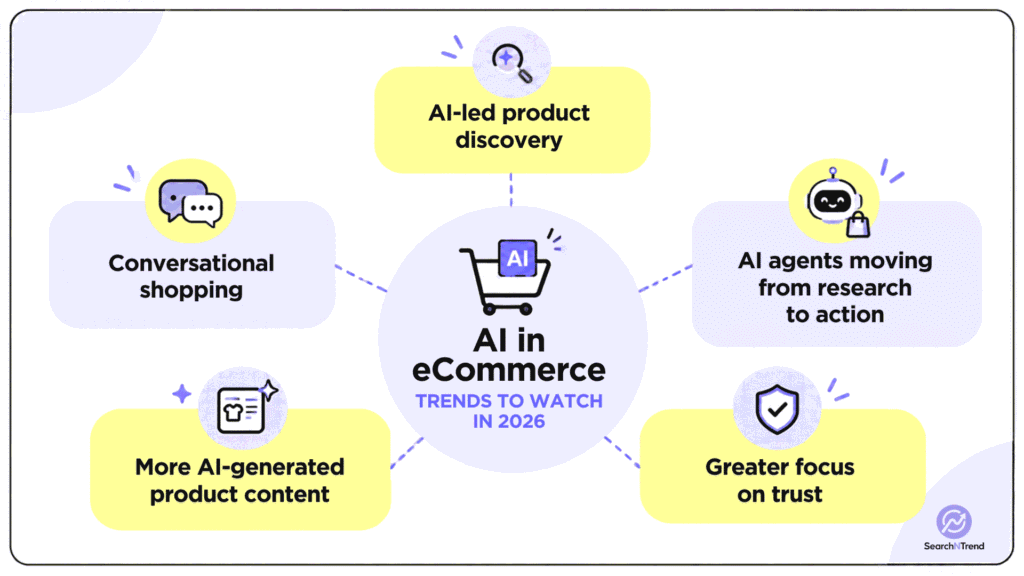
Let us take a look at these trends in eCommerce in detail below:
AI-led product discovery
More shoppers are turning to AI assistants to research products and compare options. Salesforce’s 2026 research found that agentic search as the first step in a shopping journey grew 200% year over year.
Retailers will need accurate, consistent product information across the channels where shoppers discover products, including those outside their own websites.
Conversational shopping
Adobe’s 2026 retail research found that 66% of surveyed brands said future customer experiences would need to be designed around conversational interactions.
That doesn’t mean every store needs a chatbot. It means retailers are considering ways for shoppers to describe what they need in natural language, ask follow-up questions, and narrow down their choices without relying entirely on filters and keyword searches.
AI agents moving from research to action
AI systems are moving beyond answering questions toward completing sequences of tasks. The next stage of adoption will depend on reliable integrations, secure transactions, clear customer permissions, and the ability to handle errors.
More AI-generated product content
Retailers are using generative AI to draft descriptions, summaries, category copy, and marketing assets. Human review remains important when content contains technical specifications, product claims, or information that could influence a purchase decision.
Greater focus on trust
Consumers may welcome help with product research while remaining uncomfortable with an AI system making purchases independently. Retailers will need to give shoppers control over how much autonomy an assistant has and make it easy to review important decisions.
Conclusion
AI is changing how people research products and how retailers run their businesses. The growth in AI-referred traffic, consumer use of shopping assistants, and interest in agentic commerce all point to a shift in the online shopping journey.
But adoption figures alone don’t tell the whole story. A retailer can generate more AI-referred visits without earning more revenue, and a chatbot can answer thousands of questions without improving customer satisfaction. The results depend on whether the technology solves a real problem.
For ecommerce businesses, the sensible starting point is to identify where AI can save time or make shopping easier, keep product and customer data accurate, and measure the results against a clear baseline. New tools will continue to emerge, but reliable information and customer trust will remain essential to selling online.
AI in eCommerce Statistics FAQs
Adobe reported that traffic from AI sources to U.S. retail websites grew 393% year over year in Q1 2026. It also found that 39% of surveyed U.S. consumers had used AI for online shopping. Salesforce reported 200% year-over-year growth in agentic search as the first step in a shopping journey.
Retailers use AI for product recommendations, customer service, personalized marketing, product descriptions, demand forecasting, inventory planning, fraud detection, and product discovery through AI assistants.
Adobe’s 2026 research found that 39% of surveyed U.S. consumers had used AI for online shopping. DHL’s 2026 global research reported that 38% of shoppers used AI-powered chat or virtual assistants to buy or browse online. These figures come from different studies and should not be treated as directly interchangeable.
Adobe reported that AI-referred traffic to U.S. retail websites converted 42% better than non-AI traffic in March 2026. This is an observed result from a specific dataset and period, not a guarantee that every AI implementation will improve conversions.
Agentic commerce involves AI systems carrying out multiple steps in a shopping journey, such as researching products, comparing options, checking availability, and potentially preparing or completing purchases under defined permissions.
AI assistants provide another route for shoppers to discover products. Ecommerce businesses should maintain accurate product data, accessible pages, useful content, and valid structured data while continuing to invest in traditional SEO. These practices can support discoverability, but they don’t guarantee that an AI system will recommend a product.