



WhatsApp has more than 3 billion users across more than 180 countries as of 2026. More than 2 billion people use WhatsApp every day, while the platform’s Updates tab reaches 1.5 billion people daily.
WhatsApp has also expanded well beyond personal messaging. The platform now includes business messaging, AI-powered customer support, advertising, Channels, payments, bill payments, and other commercial services.
These WhatsApp statistics show how the platform has evolved from a simple messaging app into one of the world’s largest communication and business platforms.
WhatsApp Statistics at a Glance
| WhatsApp statistic | Latest figure |
|---|---|
| WhatsApp users worldwide | 3+ billion |
| Countries using WhatsApp | 180+ |
| Daily WhatsApp users | 2+ billion |
| Daily Updates tab users | 1.5 billion |
| WhatsApp Business app users | 200+ million |
| People using WhatsApp passkeys | 1+ billion |
| Peak WhatsApp messages per second | 30+ million |
| Daily WhatsApp messages | 100+ billion |
| Daily WhatsApp calls | 2+ billion |
| Paid WhatsApp messaging annual run rate | $2+ billion |
| People messaging businesses in India | 60%+ of WhatsApp users |
| Billers available through WhatsApp in India | 22,722 |
| Bill-payment categories in India | 30 |
These figures measure different parts of WhatsApp’s ecosystem. The 3 billion-plus figure represents the platform’s global user base, while the 2 billion-plus figure represents daily users. The 1.5 billion figure applies specifically to the Updates tab, and the $2 billion figure is an annual run rate for paid WhatsApp messaging rather than WhatsApp’s total revenue.
All data mentioned in this report is sourced directly from publicly available reports and news from Meta. We browsed through hundreds of Meta reports and press releases to get the data. Some of the data, including demographics, are taken from other data sources. Wherever third-party data is mentioned, we have specified the source. If you don’t see the source, it’s directly from Meta.
WhatsApp Users Statistics
More than 3 billion people use WhatsApp worldwide as of 2026. Meta says those users are spread across more than 180 countries.
The 3 billion-plus milestone puts WhatsApp among the largest communication platforms globally. More importantly, its audience is distributed across a large number of countries rather than being concentrated in one geographic market.
Some third-party websites currently report figures such as 3.3 billion WhatsApp users. However, Meta’s latest official wording remains “more than 3 billion people”, so the 3 billion-plus figure is the more defensible number for an updated statistics article.
Source: Meta
WhatsApp Daily Active Users
More than 2 billion people use WhatsApp every day. Meta disclosed this figure in April 2025 while discussing how people communicate with businesses through WhatsApp.
The daily figure is particularly useful because it shows the frequency of WhatsApp usage rather than simply the size of its total audience. A platform with billions of users but relatively low daily activity would have a very different level of engagement.
Using the 3 billion-plus global user figure as a reference point, 2 billion daily users represents at least roughly two-thirds of the reported user base. This is a simple comparison rather than an official DAU-to-MAU ratio because Meta does not publish a corresponding current monthly active-user figure.
Source: Meta
WhatsApp Users by Year
WhatsApp has grown from 500 million users in 2014 to more than 3 billion users today.
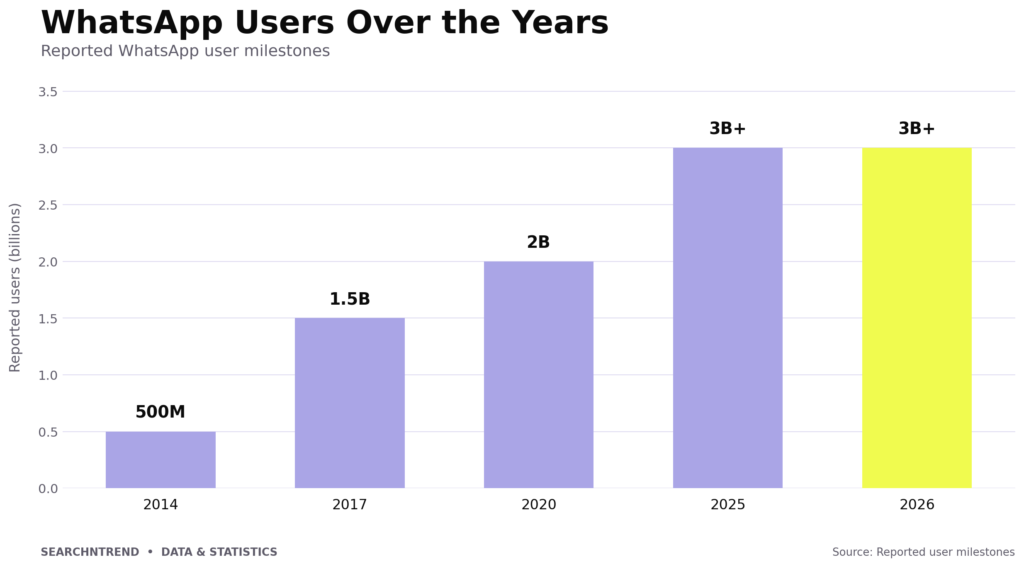
The table below highlights WhatsApp users’ growth over the years, as per the official reported data:
| Year | WhatsApp users |
|---|---|
| 2014 | 500 million |
| 2017 | 1.5 billion |
| 2020 | 2 billion |
| 2025 | 3 billion+ |
| 2026 | 3 billion+ |
These are milestone figures reported by Meta rather than a complete annual user dataset. Meta does not publish a consistent year-by-year active-user series for WhatsApp.
The platform’s growth is nevertheless substantial. WhatsApp added at least 1 billion users between its 2-billion milestone in 2020 and its 3-billion milestone.
Source: Meta
WhatsApp Users Growth
WhatsApp has added at least 1 billion users since reaching 2 billion users in 2020.
That growth happened alongside a major expansion in the platform’s functionality. WhatsApp is no longer focused solely on private messaging; it now includes business tools, Channels, advertising, AI, commerce, and payments.
The important trend is therefore not just the number of people joining WhatsApp. The platform is also increasing the number of activities those users can complete inside the app.
WhatsApp Users by Country
India is one of WhatsApp’s largest markets, but Meta does not currently publish an official country-by-country WhatsApp user table.
Third-party sources publish country-level estimates, but these figures can use different methodologies, survey populations, and reporting dates. They should therefore not be combined with Meta’s global figure as though they were measured using the same methodology.
For SearchNTrend, official Meta figures should be used wherever available, while country-level estimates should be clearly labeled as estimates.
Source: Meta
WhatsApp Users in the United States
32% of U.S. adults reported using WhatsApp in 2025, according to Pew Research Center. That was up from 23% in 2021, representing a 9-percentage-point increase.
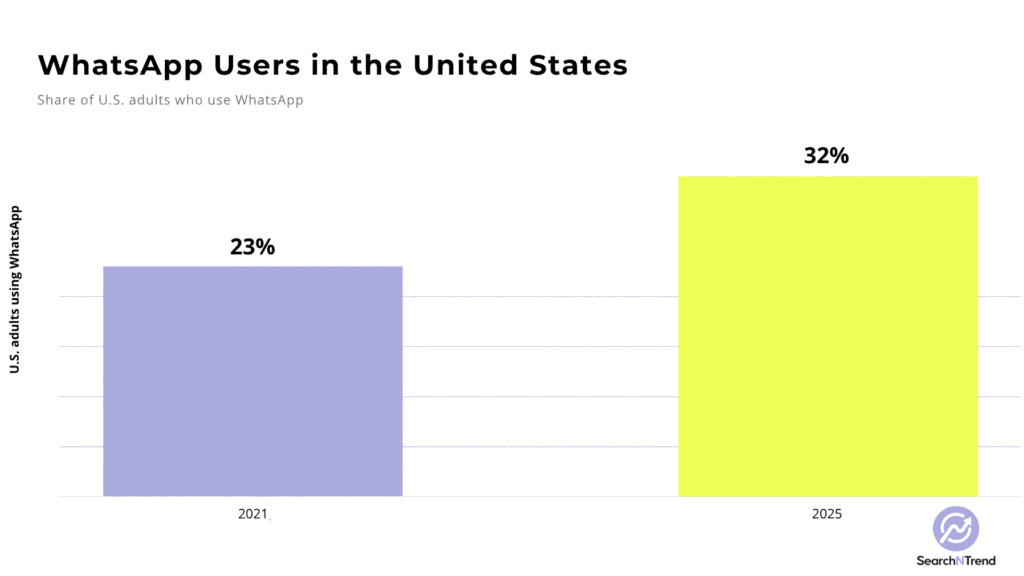
| Year | U.S. adults using WhatsApp |
|---|---|
| 2021 | 23% |
| 2025 | 32% |
WhatsApp’s U.S. adoption is lower than in some markets where it functions as a default messaging platform, but the increase indicates that its U.S. audience has continued to expand.
Source: Pew Research Center
WhatsApp Demographics
WhatsApp users by age and gender vary widely. Here is a closer look at the data:
WhatsApp Users by Age
In the United States, WhatsApp usage is highest among adults aged 18–29 and 30–49. Pew Research Center reported usage rates of 40% and 39%, respectively, in 2025.
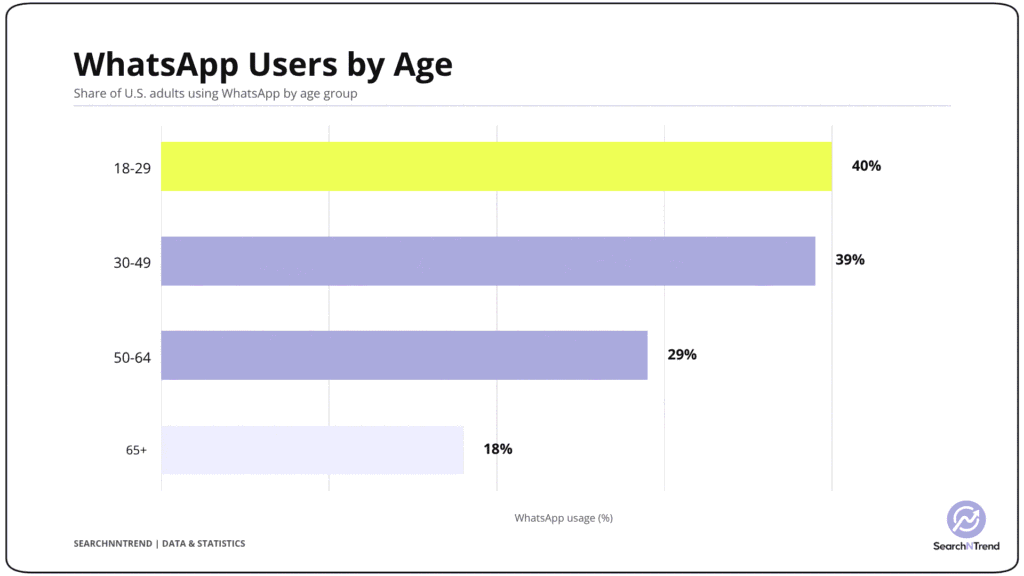
Let us take a look at WhatsApp users by age below:
| Age group | U.S. adults using WhatsApp |
|---|---|
| 18–29 | 40% |
| 30–49 | 39% |
| 50–64 | 29% |
| 65+ | 18% |
The figures show that WhatsApp is not exclusively a Gen Z platform. Adoption among adults aged 30–49 is almost identical to adoption among 18–29-year-olds.
These figures represent U.S. adults and should not be presented as WhatsApp’s global age distribution.
Source: Pew Research Center
WhatsApp Users by Gender
34% of U.S. women and 30% of U.S. men reported using WhatsApp in 2025.
The four-percentage-point difference is relatively small compared with the differences Pew found across age and ethnicity.
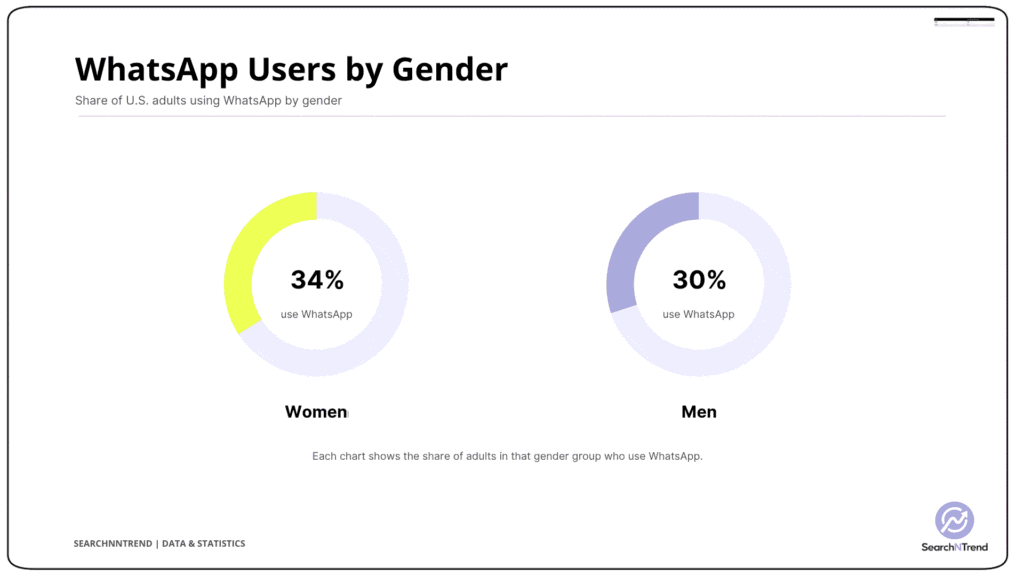
As with the age data, these figures represent U.S. adults rather than WhatsApp’s global audience.
Source: Pew Research Center
WhatsApp Users by Ethnicity
WhatsApp usage varies substantially across racial and ethnic groups in the United States.
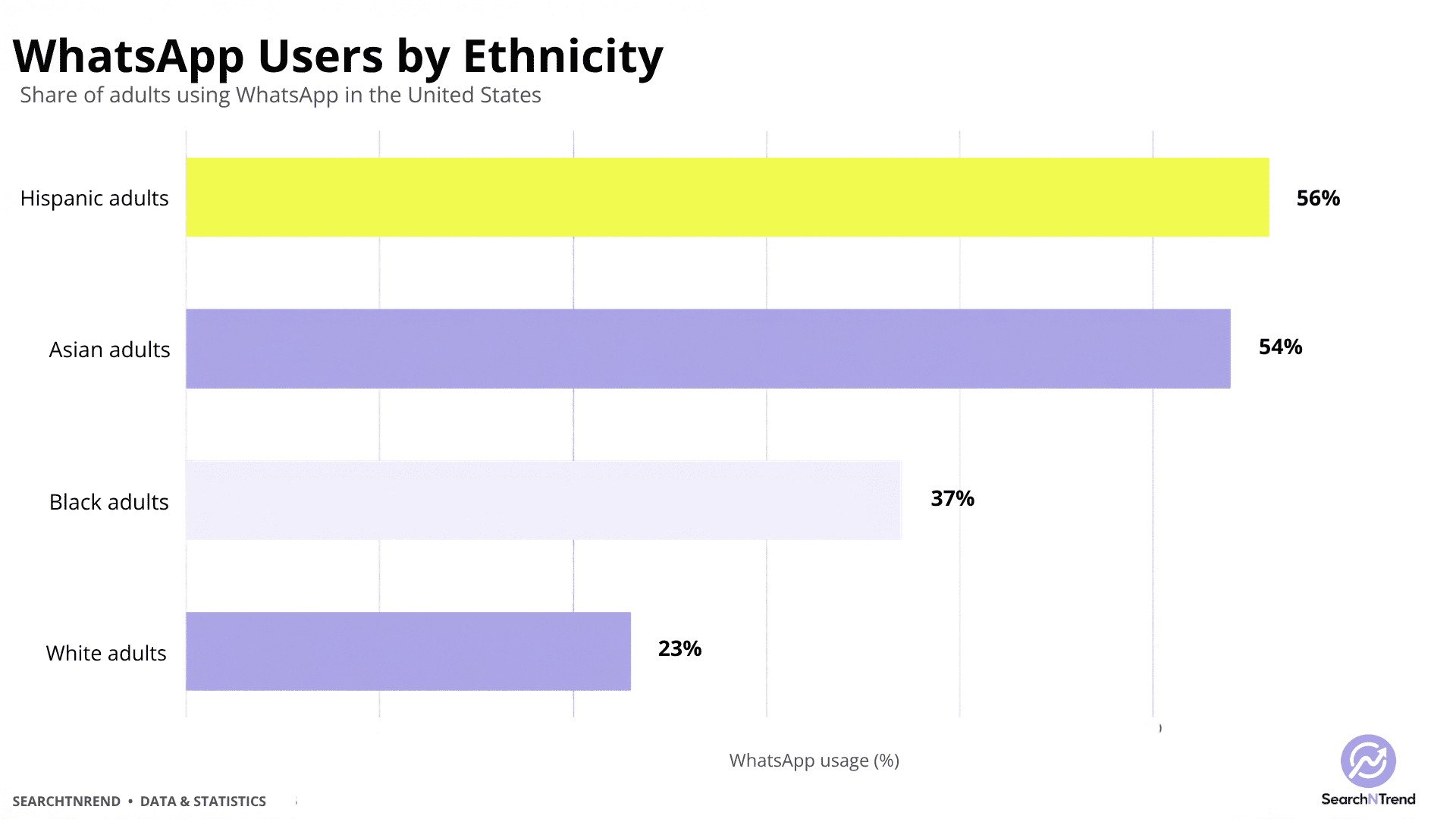
Pew Research Center reported the following adoption rates in 2025:
| Group | WhatsApp usage |
|---|---|
| Hispanic adults | 56% |
| Asian adults | 54% |
| Black adults | 37% |
| White adults | 23% |
WhatsApp adoption among Hispanic adults was more than twice the rate among White adults in the survey.
The difference shows why a single national adoption figure can hide substantial variations in audience composition.
Source: Pew Research Center
WhatsApp Usage Statistics
Let us now dive deep into how WhatsApp is used on a day-to-day basis:
WhatsApp Messages Per Day
WhatsApp facilitates more than 100 billion messages on a typical day, according to WhatsApp.
The figure gives a better sense of the platform’s communication volume than its user count alone. With more than 3 billion users globally, 100 billion daily messages illustrate how heavily the service is used for recurring conversations.
This is a company-reported daily figure rather than a third-party estimate.
Source: Meta
WhatsApp Messages Per Second
A normal day of 100 billion WhatsApp messages works out to approximately 1.16 million messages per second.
This is a calculation based on WhatsApp’s reported 100 billion daily messages:
100 billion ÷ 86,400 seconds = approximately 1.16 million messages per second.
The number should not be confused with WhatsApp’s peak messaging rate during major events.
Source: Meta
WhatsApp Peak Messaging Volume
WhatsApp exceeded 29 million messages per second during a 2026 FIFA World Cup Round of 16 match between Argentina and Egypt.
That was a new all-time record at the time, demonstrating how quickly WhatsApp’s messaging infrastructure can scale during major global events.
A peak of 29 million messages per second is roughly 25 times the average rate implied by 100 billion messages per day.
Source: Meta
WhatsApp Calls Per Day
WhatsApp facilitates around 2 billion calls on a normal day, according to WhatsApp.
The figure shows that WhatsApp is not only a text-messaging platform. Voice and video communication form a substantial part of everyday activity on the service.
When combined with its daily messaging volume, the figure highlights how WhatsApp functions as a broader communications platform rather than simply a chat application.
WhatsApp Updates Users
The WhatsApp Updates tab is used by 1.5 billion people every day.
The Updates tab contains Status and Channels and is separate from users’ personal chats.
Its scale is particularly important because Meta is using the tab as the primary location for new monetization products, including ads in Status, promoted channels, and channel subscriptions.
How Many People Use WhatsApp Business?
More than 200 million people use the WhatsApp Business app worldwide.
This is a user figure for the WhatsApp Business application and should not be interpreted as 200 million businesses.
The distinction is important because one business may have multiple employees or representatives using the service.
WhatsApp Business Adoption in India
More than 60% of people on WhatsApp in India message a business account.
The figure demonstrates how deeply WhatsApp has become embedded in commercial communication in India.
Meta has also cited a Kantar 2025 report showing that 91% of online adults in India chat with businesses weekly. That figure applies to online adults and business messaging more broadly, so it should not be treated as the same measurement as the 60% WhatsApp figure.
WhatsApp Business Conversations
More than 1 billion active business conversation threads occur every day across WhatsApp, Messenger and Instagram.
This is a combined Meta figure and does not mean that 1 billion business conversations happen on WhatsApp alone.
It does, however, show the scale of messaging as a business channel across Meta’s ecosystem.
WhatsApp Business AI
More than 1 million businesses are using Meta Business Agent on WhatsApp and Messenger.
Meta Business Agent is designed to answer customer questions, recommend products, qualify leads, and book appointments.
Meta also reported that Business AIs in Mexico and the Philippines were generating more than 1 million weekly conversations during the early rollout.
The development marks a shift from WhatsApp simply connecting customers with businesses to allowing AI systems to handle parts of those conversations.
WhatsApp Revenue Statistics
Meta does not publicly disclose WhatsApp’s total standalone annual revenue.
WhatsApp is reported within Meta’s broader Family of Apps financial reporting rather than as a separate revenue line.
This is important because several third-party websites publish estimated WhatsApp revenue figures that can appear to be official. Unless Meta reports the figure directly or the methodology behind an estimate is transparent, it should not be presented as WhatsApp’s actual revenue.
WhatsApp Paid Messaging Revenue
Paid WhatsApp messaging crossed a $2 billion annual run rate in Q4 2025.
An annual run rate is not the same as $2 billion in revenue generated during the quarter. It means the pace of revenue at that point would equal more than $2 billion if maintained for a full year.
This is currently one of the clearest official indicators of WhatsApp’s monetization scale.
WhatsApp Business Model
WhatsApp’s monetization is increasingly centered on business messaging, advertising, and commercial features rather than charging users for basic messaging.
Meta has expanded paid business messaging while introducing ads in Status, promoted channels, and channel subscriptions.
The strategy gives Meta multiple ways to monetize WhatsApp while keeping personal chats separate from advertising placements.
WhatsApp Advertising Statistics
Let’s take a look at how advertising has changed and grown on WhatsApp.
WhatsApp Ads in Status
WhatsApp’s Updates tab, which includes Status, reaches 1.5 billion people every day.
Meta introduced ads in Status as part of its broader effort to help businesses and creators reach people through WhatsApp without placing advertisements inside personal chats.
Users can discover a business through a Status advertisement and start a conversation about the advertised product or service.
WhatsApp Promoted Channels
Promoted Channels are part of WhatsApp’s new Updates-tab monetization system.
Meta introduced promoted channels alongside Status advertising and channel subscriptions to help businesses, organizations and creators increase discovery.
The products are designed to appear in the Updates area rather than personal conversations.
WhatsApp Channel Subscriptions
WhatsApp allows Channel admins to offer paid subscriptions through the Updates tab.
The feature gives creators and organizations another potential monetization method inside WhatsApp while keeping subscription activity separate from personal chats.
WhatsApp Commerce Statistics
WhatsApp has gone from a personal messaging app to a fully-fledged commerce app, allowing users to make payments, recharges, etc.
WhatsApp Payments
WhatsApp is expanding into payments and commercial transactions, particularly in India.
The platform has added payment-related functionality that allows businesses to accept payments through WhatsApp Business, while users can access additional payment and commerce services directly within the app.
The expansion means WhatsApp is increasingly being used as a transaction layer rather than simply a communication channel.
WhatsApp Bill Payments in India
WhatsApp’s bill-payment service in India provides access to 22,722 billers across 30 categories.
The service is powered by the Bharat Connect network and includes electricity, gas, water, FASTag, insurance, credit card, and loan repayments.
The development is significant because users can now complete everyday financial tasks from the same app they already use for communication.
WhatsApp Mobile Recharge in India
WhatsApp users in India can recharge prepaid mobile connections from Jio, Airtel and Vi directly inside the app.
Meta introduced the feature in April 2026, allowing users to browse plans and complete prepaid recharges without switching to another application.
This is another example of WhatsApp’s shift toward becoming a utility platform in markets where the service already has large-scale adoption.
WhatsApp AI Statistics
AI has been integrated into WhatsApp at a rapid pace. Here is what the data tells us:
WhatsApp Business AI
More than 1 million businesses are using Meta Business Agent on WhatsApp and Messenger.
The tool can answer customer questions, recommend products, qualify leads, and book appointments.
Meta is also expanding Business AI capabilities so that businesses can use AI to handle more of the customer journey directly within WhatsApp.
WhatsApp Business AI Conversations
Business AIs in Mexico and the Philippines were generating more than 1 million weekly conversations during Meta’s early rollout.
The figure demonstrates that Meta’s AI strategy is already producing measurable conversational activity rather than remaining limited to experimental features.
WhatsApp Privacy and Security Statistics
More than 1 billion people have set up passkeys for WhatsApp.
Passkeys allow users to authenticate using device-based security such as a fingerprint, Face ID, or screen-lock code.
Reaching more than 1 billion users makes passkeys one of WhatsApp’s largest security feature adoptions.
WhatsApp Scam Accounts Statistics
WhatsApp removed more than 6.8 million accounts linked to criminal scam centers during the first half of 2025.
Meta said the accounts were linked to criminal scam centers targeting people online around the world.
The figure should not be interpreted as the total number of scam or spam accounts on WhatsApp. It specifically covers accounts Meta identified as linked to criminal scam centers.
WhatsApp End-to-End Encryption
WhatsApp personal messages and calls are end-to-end encrypted by default.
End-to-end encryption means the content of personal conversations is designed to remain accessible only to the participants in the conversation.
Meta has also emphasized that new monetization features such as ads in Status are separated from personal chats, which remain end-to-end encrypted.
WhatsApp Features Statistics
Here are the features of WhatsApp and how it is used:
WhatsApp Status
WhatsApp’s Updates tab, which includes Status, is used by 1.5 billion people every day.
Status has therefore become much more than a secondary feature. Its scale gives Meta a large audience for business discovery and advertising.
How Many Users Does WhatsApp Channels Reach?
WhatsApp Channels are part of the Updates tab, which reaches 1.5 billion people every day.
Meta has introduced promoted channels and paid channel subscriptions as ways for creators, organizations and businesses to grow and monetize their audiences.
WhatsApp Voice and Video Calls
WhatsApp handles around 2 billion calls on a typical day.
The figure demonstrates that calling remains a major component of WhatsApp usage alongside text messaging.
Source: Meta
WhatsApp Usernames
WhatsApp began rolling out usernames in 2026, giving users the option to connect without immediately sharing their phone number.
Meta says usernames are designed to provide another layer of privacy when people connect for the first time.
The feature is particularly relevant for creators, small businesses, and organizations that want a consistent identity without exposing a phone number to every new contact.
WhatsApp Statistics by Region
Let us take a look at how WhatsApp is used in different regions:
WhatsApp Usage in Asia
Asia contains some of WhatsApp’s most important markets, including India.
India’s large WhatsApp audience and extensive business usage make the country particularly important to Meta’s WhatsApp strategy.
The platform’s expansion into mobile recharges, bill payments, business AI, and other services in India also shows how regional usage can influence product development.
WhatsApp Usage in North America
32% of U.S. adults reported using WhatsApp in 2025.
U.S. adoption is lower than in some markets where WhatsApp is the dominant messaging service, but the platform has continued to expand its American audience.
Source: Pew Research Center
WhatsApp Usage in Latin America
WhatsApp has a substantial presence across Latin American markets, although Meta does not publish a current official country-by-country user table.
Country-level figures therefore need to be sourced from individual surveys or transparent third-party datasets rather than treated as official Meta user counts.
WhatsApp Statistics for Businesses
Millions of people already use WhatsApp to communicate with businesses, while Meta says more than 1 billion business conversation threads occur daily across its messaging platforms.
WhatsApp’s customer-service role has expanded from simple text conversations to calls, AI support, product discovery, and automated assistance.
WhatsApp Marketing
Meta is integrating WhatsApp more closely with its advertising ecosystem through Status ads and centralized campaign management.
Businesses can manage marketing campaigns across WhatsApp, Facebook, and Instagram through Meta’s advertising tools.
This gives WhatsApp a stronger role in the customer journey, where users can discover a business and immediately begin a conversation.
WhatsApp Sales and Commerce
WhatsApp is increasingly being used to move customers from discovery to conversation and transaction.
Meta has introduced business payments, mobile recharges, bill payments and additional commerce functionality, particularly in India.
The significance is that WhatsApp can now support multiple stages of a purchase journey without requiring the customer to move between several applications.
WhatsApp Growth and Future Trends
WhatsApp’s business ecosystem is expanding through messaging, AI, payments and advertising.
More than 200 million people use the WhatsApp Business app, while Meta is adding AI-powered customer support and business discovery tools.
The growth therefore involves more than adding businesses to the platform. It also involves increasing the number of commercial activities that can happen inside WhatsApp.
WhatsApp AI Growth
Meta is expanding AI deeper into WhatsApp Business, with more than 1 million businesses already using Meta Business Agent on WhatsApp and Messenger.
Business AI is being developed to answer questions, recommend products, qualify leads, book appointments, and eventually facilitate more actions directly within conversations.
WhatsApp Advertising Growth
The 1.5 billion daily users of the Updates tab give Meta a large audience for WhatsApp’s newer advertising products.
Ads in Status and promoted channels are being introduced outside personal chats, creating a separate commercial environment within the app.
WhatsApp Commerce Growth
WhatsApp is expanding into commerce and everyday services, particularly in India.
Mobile recharges, bill payments, business payments, and other services are increasingly available inside WhatsApp.
The broader trend is a shift from WhatsApp as a place where users discuss transactions to a platform where users can increasingly complete them.
Other relevant statistics to check out:
Conclusion
WhatsApp’s latest statistics show a platform that has moved far beyond basic messaging.
With more than 3 billion users, more than 2 billion daily users and more than 100 billion messages on a typical day, WhatsApp already operates at a scale few communication platforms can match.
But its most important development is happening beyond its core messaging product. The 1.5 billion daily Updates audience, growing business-messaging revenue, AI-powered business tools, advertising products, and expanding payment and commerce features are changing what people and businesses can do inside the app.
The clearest trend is therefore not simply WhatsApp’s user growth. It is the expansion of the WhatsApp ecosystem itself, from messaging and calling to business communication, content discovery, AI, payments and commerce.
WhatsApp Statistics FAQs
As of 2026, more than 3 billion people use WhatsApp across more than 180 countries.
More than 2 billion people use WhatsApp every day.
WhatsApp facilitates more than 100 billion messages on a typical day.
WhatsApp has recorded a peak of more than 29 million messages per second. The record was set during the 2026 FIFA World Cup Round of 16 match between Argentina and Egypt.
There is no single official figure for all businesses using WhatsApp. More than 200 million people use the WhatsApp Business app, while more than 1 million businesses were using Meta Business Agent on WhatsApp and Messenger in 2026.
More than 200 million people use the WhatsApp Business app worldwide.
Meta does not disclose WhatsApp’s total standalone revenue. However, paid WhatsApp messaging crossed a $2 billion annual run rate in Q4 2025.
India is one of WhatsApp’s largest markets, but Meta does not publish a current official country-by-country user ranking. Country-level figures from third-party sources should therefore be treated as estimates rather than official Meta statistics.
WhatsApp generates revenue primarily through business messaging and newer commercial products. Meta has also introduced ads in Status, promoted channels and channel subscriptions.