



Global social media usage has expanded to include a massive share of the human population, transitioning these spaces from basic communication tools into dominant components of everyday life. As platforms optimize algorithms to capture maximum consumer attention, compulsive usage patterns have risen proportionately.
This end to end report aggregates verified statistical data detailing the prevalence, demographic distributions, geographic variances, and platform specific behavioral metrics defining social media dependency.
📊 Data Disclaimer
All statistics and figures referenced in this article are sourced from publicly available data portals, research reports, and third-party platforms. SearchnTrend does not generate or own this data. Numbers may fluctuate as original sources update their reports over time. For full source details, see the References section at the bottom of this article.
How Many People Are Addicted to Social Media Globally?
An estimated 210 million people worldwide suffer from social media addiction, representing approximately 3.7% to 3.9% of the total global social media user base.
The global digital footprint has expanded significantly, reaching a total scale of approximately 5.66 billion active social media accounts. While the overwhelming majority of individuals interact with these networks for standard communication and entertainment, a distinct sub-population displays clinical signs of dependency.
These signs include an inability to regulate screen time, experiencing psychological distress when offline, and prioritizing digital engagement over professional, academic, or real world social responsibilities.
| Global Social Media User Metric | Statistical Value |
|---|---|
| Total Global Social Media Users | 5.66 Billion |
| Global Population Penetration Rate | 69.0% |
| Adult Population (18+) Penetration Rate | 84.0% |
| Estimated Population Experiencing Addiction | 210 Million |
| Year-over-Year User Base Growth Rate | 2.4% |
Clinical metrics indicate that digital dependency conditions vary widely by local demographic environments and research methodology, with localized addiction ranges spanning between 5% and 31% depending on the specific country studied.
- The total number of individuals experiencing social media dependency in the United States alone has reached 33.14 million users, which equates to roughly 10% of the domestic population.
- The average multi-platform footprint shows that the typical global internet user maintains active profiles across 6.7 different social networks simultaneously.
- Comprehensive clinical meta-analyses indicate that over 17% of the global population shows generalized susceptibility to at least one form of problematic online behavior or platform dependency.
Social Media Addiction By Age
Generation Z users aged 18 to 22 experience the highest rate of social media addiction, with 40% of this specific demographic group reporting compulsive or dependent usage behaviors.
Age correlates strongly with the risk of developing problematic social media habits. Younger generations who entered their formative developmental years alongside the rise of smartphones exhibit significantly higher vulnerability to algorithmic engagement loops.
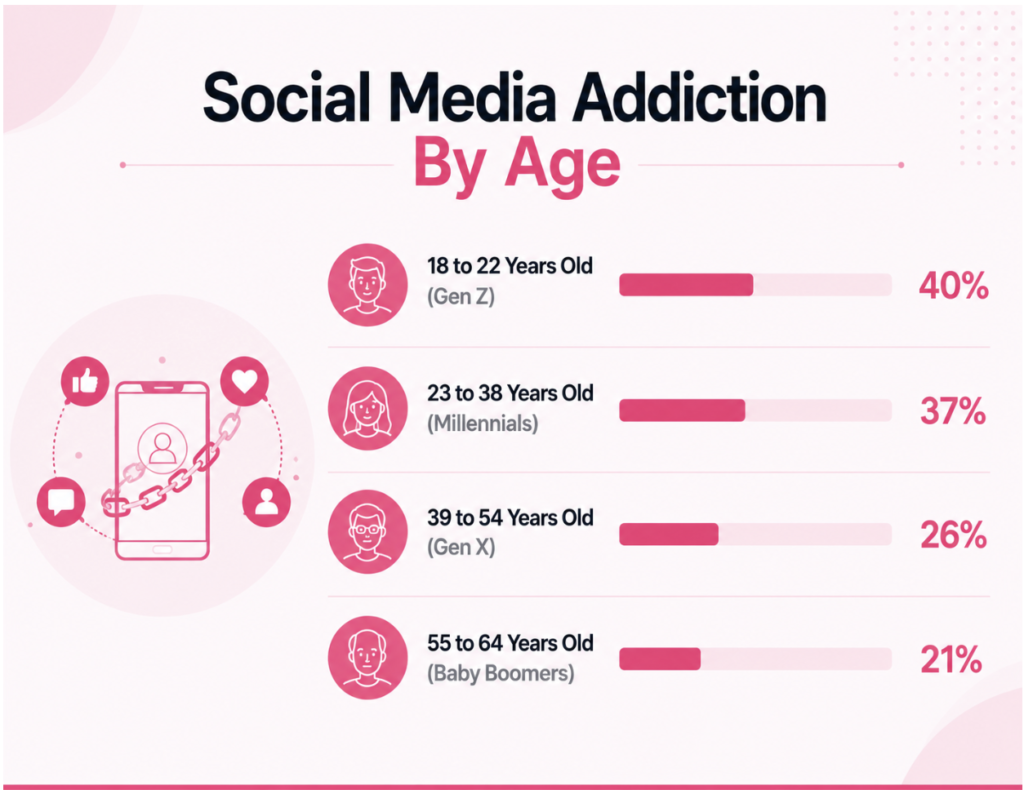
The primary behavioral drivers among the youngest adult cohort are heavy daily engagement histories, intense peer validation requirements, and elevated levels of the fear of missing out (FOMO). As age increases, dependency risk systematically scales down, reflecting different motives for platform usage.
| Age Group / Generation | Social Media Addiction Rate | Primary Usage Drivers |
|---|---|---|
| 18 to 22 Years Old (Gen Z) | 40% | Heavy daily usage cycles, peer validation dynamics, and FOMO |
| 23 to 38 Years Old (Millennials) | 37% | High workplace integration, professional networking, and social maintenance |
| 39 to 54 Years Old (Gen X) | 26% | Purpose driven communications, utility tracking, and limited platform varieties |
| 55 to 64 Years Old (Baby Boomers) | 21% | Basic interpersonal communication loops and general news consumption |
Adolescents and children exhibit even higher markers of structural vulnerability due to ongoing neurological development, leaving them highly responsive to immediate dopamine rewards.
- A global assessment by the World Health Organization shows that 11% of all adolescents display structurally unhealthy social media habits, struggling significantly to limit their daily screen time.
- Longitudinal data reveals that the rate of adolescent social media addiction expanded from 7% to 11% over a recent four year observation window.
- Within the United States academic environment, upwards of 60% of surveyed students explicitly self report feeling addicted to social media networks.
- Surveys tracking extreme youth connectivity indicate that 46% of teenagers describe their overall internet use as almost constant.
- Structural usage tracking reveals that approximately 95% of children aged 10 to 17 use social networks constantly throughout their daily routines.
Teen Social Media Dynamics and AI Integration
The digital environment for teenagers aged 13 to 17 is characterized by near-ubiquitous connectivity and the emergence of artificial intelligence tools as daily utilities. Data tracking American teenagers reveals that 96 percent engage with the internet daily, and 36 percent acknowledge utilizing at least one major social platform almost constantly.
Platform preference among teenagers diverges starkly from older adult demographics. YouTube secures the highest overall penetration, with 92 percent of all teens utilizing the platform and 76 percent accessing it multiple times per day.
TikTok and Instagram follow as the primary drivers of peer-to-peer engagement and trend replication. Conversely, legacy platforms like Facebook have experienced severe decay in this segment, with only 31 percent of teens accessing the app, and a mere 20 percent engaging on a daily basis.
| Social Platform | Total Teen Penetration Rate | Daily Active Teen Usage Rate | Almost Constant Usage Rate |
|---|---|---|---|
| YouTube | 92% | 76% | 20% |
| TikTok | 63% | 61% | 20% |
| 61% | 55% | 12% | |
| Snapchat | 55% | 46% | 12% |
| 31% | 20% | 3% |
Gender-based variances remain highly pronounced within teen usage patterns. Teen girls demonstrate higher affinity and daily active usage for Snapchat (61 percent vs. 49 percent for boys) and Instagram. Teen boys exhibit higher concentration on YouTube (94 percent vs. 89 percent for girls) and specialized platform structures like Reddit (21 percent vs. 12 percent for girls).
Generative AI tools have achieved deep integration into teen workflows. Roughly 64 percent of all teenagers utilize AI chatbots, with 30 percent deploying them daily for academic research, entertainment, or emotional processing. OpenAI’s ChatGPT maintains complete dominance in this sector, used by 59 percent of the teen cohort, outstripping competitors like Google Gemini and Meta AI. Older teenagers aged 15 to 17 adopt these tools at significantly higher rates than younger adolescents, demonstrating a clear link between academic advancement and AI utility adoption.
Social Media Addiction by Gender
Adolescent girls experience problematic social media usage at a rate of 13%, whereas adolescent boys exhibit a lower rate of 9%.
The behavioral presentation of digital dependency varies distinctly between male and female user bases. Female demographic groups are highly susceptible to feed based platforms that leverage social comparison, visual aesthetics, and interpersonal validation metrics. Conversely, male user groups tend to develop dependency issues centered on interactive environments and gaming architectures.
This division means that while girls dominate the metrics for core social media addiction, boys lead in adjacent categories of online dependency.
- Data tracking male adolescent behaviors shows that 16% of boys are at risk of problematic or compulsive online gaming practices.
- The proportion of adolescent boys displaying severe, problematic usage patterns specifically on standard social networking applications stands at just over 6%.
- Gendered time tracking on short-form video applications reveals that women spend an average of 112 minutes per day on TikTok, compared to 91 minutes per day for men.
- Internal research tracking platform-specific vulnerability shows that nearly 33% of teenage girls who experience preexisting body dissatisfaction state that using Instagram directly worsens their condition.
- Teen girls report substantially higher levels of perceived pressure to maintain curated online aesthetics, look attractive, post popular content, and respond immediately to notifications.
Social Media Addiction By Country
Nigeria ranks first globally for daily social media screen time, with users averaging 4 hours and 49 minutes per day, followed closely by the Philippines at 4 hours and 1 minute.
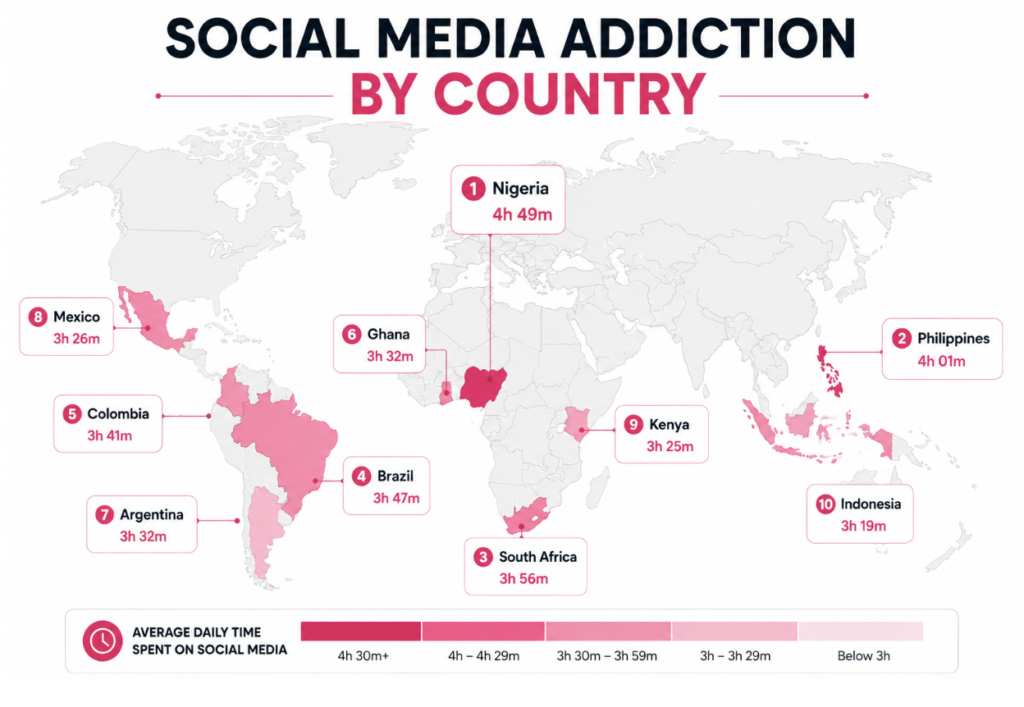
Geographic distribution patterns show that emerging and developing digital economies exhibit the highest average daily time spent on social platforms. Populations in these regions frequently rely on mobile-first digital ecosystems where social platforms function as the primary gateway to the broader internet, entertainment, and commercial services. Mature European digital markets generally track at lower daily usage rates, though regional variation remains pronounced based on local cultural and regulatory structures.
| Global Rank | Country | Average Daily Time Spent on Social Media |
|---|---|---|
| 1 | Nigeria | 4 Hours, 49 Minutes |
| 2 | Philippines | 4 Hours, 01 Minute |
| 3 | South Africa | 3 Hours, 56 Minutes |
| 4 | Brazil | 3 Hours, 47 Minutes |
| 5 | Colombia | 3 Hours, 41 Minutes |
| 6 | Ghana | 3 Hours, 32 Minutes |
| 7 | Argentina | 3 Hours, 32 Minutes |
| 8 | Mexico | 3 Hours, 26 Minutes |
| 9 | Kenya | 3 Hours, 25 Minutes |
| 10 | Indonesia | 3 Hours, 19 Minutes |
Outside of the top ten high duration markets, developed industrial economies present completely different behavioral profiles.
- The average American social media consumer spends 2 hours and 15 minutes to 2 hours and 30 minutes per day navigating these applications.
- In the Indian digital market, more than 33% of young urban internet users are categorized as possessing an active social platform dependency.
- European regional tracking reveals that Romania maintains one of the continent’s highest adolescent dependency rates at 22%.
- The Netherlands records one of the lowest domestic platform dependency baselines in the European region, with only 5% of its youth population meeting addiction criteria.
What Is the Average Daily Time Spent on Social Media?
The typical global internet user spends 2 hours and 23 minutes every day on social platforms, adding up to roughly 36.3 days of continuous navigation per year.
While total year over year growth across the global social media space has leveled off to a modest 2.4% annually, the depth of daily engagement remains historically high. This stability in average daily time masks a massive structural shift in consumer habits. Users are moving away from traditional, passive scrolling on home feeds toward high-frequency, short-duration opens driven by short-form video consumption and direct message coordination.
- The cumulative annual time investment for an average user equals more than 860 hours spent inside social application interfaces.
- Modern application behavior is characterized by shorter individual session lengths paired with a major spike in total daily application opens.
- Over 50% of all user time spent inside Meta’s Instagram platform is now dedicated entirely to viewing Reels video content.
- Private messaging interactions via platforms like WhatsApp, Telegram, and Messenger now command roughly 60% of all accumulated social application screen time.
- In the domestic United States market, teenagers and young adults average between 3 and 5 hours of social media navigation every single day.
Which Social Media Platform Has the Highest Engagement and Dependency Metrics?
TikTok is the most engaging and highly addictive social media application globally, commanding an average daily user investment of 95 minutes per day.
The design architecture of modern social platforms plays a decisive role in generating compulsive user patterns. TikTok utilizes a discovery engine optimized around real-time behavioral feedback rather than static social graphs, producing incredibly long session times. This loop keeps users within the app for nearly three times longer than rival platforms. However, standard networks like YouTube and Facebook continue to retain deep, pervasive historical usage across broader adult demographics.
| Social Media Platform | Average Daily Time Per User |
|---|---|
| Social Media Platform | Average Daily Time Per User |
| TikTok | 95 Minutes |
| YouTube | 40-50 Minutes |
| 35 Minutes | |
| 30 Minutes |
Analyses of user interaction mechanics across these top applications demonstrate how different systems cultivate compulsive usage.
- The average individual TikTok session lasts for 10 minutes and 51 seconds, a length that eclipses the primary interaction metrics of all major competitors.
- Roughly 73% of all active TikTok users open the application multiple times throughout the course of a single day.
- The average active consumer on short-form video applications watches approximately 92 distinct video clips per day.
- Gen Z users under the age of 26 exhibit extreme platform isolation, averaging 152 minutes per day inside TikTok interfaces.
- Internal product assessments leaked from Facebook indicate that 12.5% of its user base, roughly 360 million individuals, experience severe compulsive usage that harms sleep, employment, or relationships.
- Pervasive platform penetration tracking shows that 90% of all American teenagers actively utilize YouTube, while 63% engage with TikTok and 61% maintain Instagram profiles.
- Teenage usage of legacy feed platforms has collapsed, with only 32% of teens aged 13 to 17 using Facebook, compared to 71% recorded in 2015.
What Are the Primary Psychological and Behavioral Symptoms of Social Media Dependency?
Exactly 72% of all social media users inspect their accounts within 10 minutes of waking up, demonstrating a systemic alteration in morning behavioral habits.
Social media platforms exploit natural human psychological vulnerabilities by utilizing variable reward schedules that mimic the structural mechanics of traditional slot machines. Every like, notification, comment, or algorithmic video delivery triggers a localized release of dopamine in the brain. Over extended periods, this frequent stimulation alters reward pathways, creating acute behavioral modifications, emotional volatility when offline, and measurable drops in cognitive focus.
- Approximately 50% of modern social media account holders actively inspect their digital feeds multiple times per hour throughout the day.
- Nearly 30% of young adults experience physiological restlessness, anxiety, or acute irritability when their digital connectivity is severed.
- Adolescents who spend between 5 and 7 hours per day on social platforms are twice as likely to receive clinical diagnoses of depression or anxiety compared to low-usage peers.
- Over 42% of teenagers state that their personal social media application screen time actively prevents them from participating in face-to-face peer socialization.
- Meta internal tracking data reveals that 8.4% of adolescent Instagram accounts aged 13 to 15 are exposed to explicit self-harm content during any given week.
- Half of all adolescents aged 13 to 17 state that the photographic content hosted on social platforms makes them feel worse about their physical body image.
Other statistics to check out:
How Are Lawsuits and Public Policy Measures Responding to Social Media Addiction?
More than 2,890 active product liability lawsuits have been filed against major technology corporations, including Meta, ByteDance, Alphabet, and Snap Inc regarding intentional addictive design.
The scaling public health data linking compulsive platform usage to mental health challenges has triggered widespread legal and regulatory pushback. Mass tort litigation alleges that major tech companies deliberately designed their algorithms to bypass parental controls and hook vulnerable youth demographics. This legal shift is accompanied by a major transition in public sentiment, with broad majorities now demanding structural state intervention to regulate minors’ access to digital platforms.
- A clear majority of 56% of all United States adults support passing complete statutory bans preventing anyone under the age of 16 from accessing social media platforms.
- Bipartisan consumer policy tracking indicates that 85% of citizens favor forcing social media enterprises to obtain explicit parental consent before allowing minors to build new accounts.
- Approximately 78% of adults support state-mandated age verification checkpoints to block underage access to social software systems.
- A matching 78% of the public supports legally requiring tech platforms to build hard-coded daily usage time limits for minor accounts.
- Public sentiment among youth populations is shifting, with 48% of teens now stating that social media exerts a mostly negative impact on their immediate peer group.
- Self regulation tracking reveals that 44% of teenagers have actively attempted to manually cut back on their smartphone and social application usage time.
References
-
DataReportal — Global Digital Insights
https://datareportal.com/ -
World Health Organization (WHO)
https://www.who.int/ -
Pew Research Center
https://www.pewresearch.org/ -
Sensor Tower — Mobile App Intelligence
https://sensortower.com/