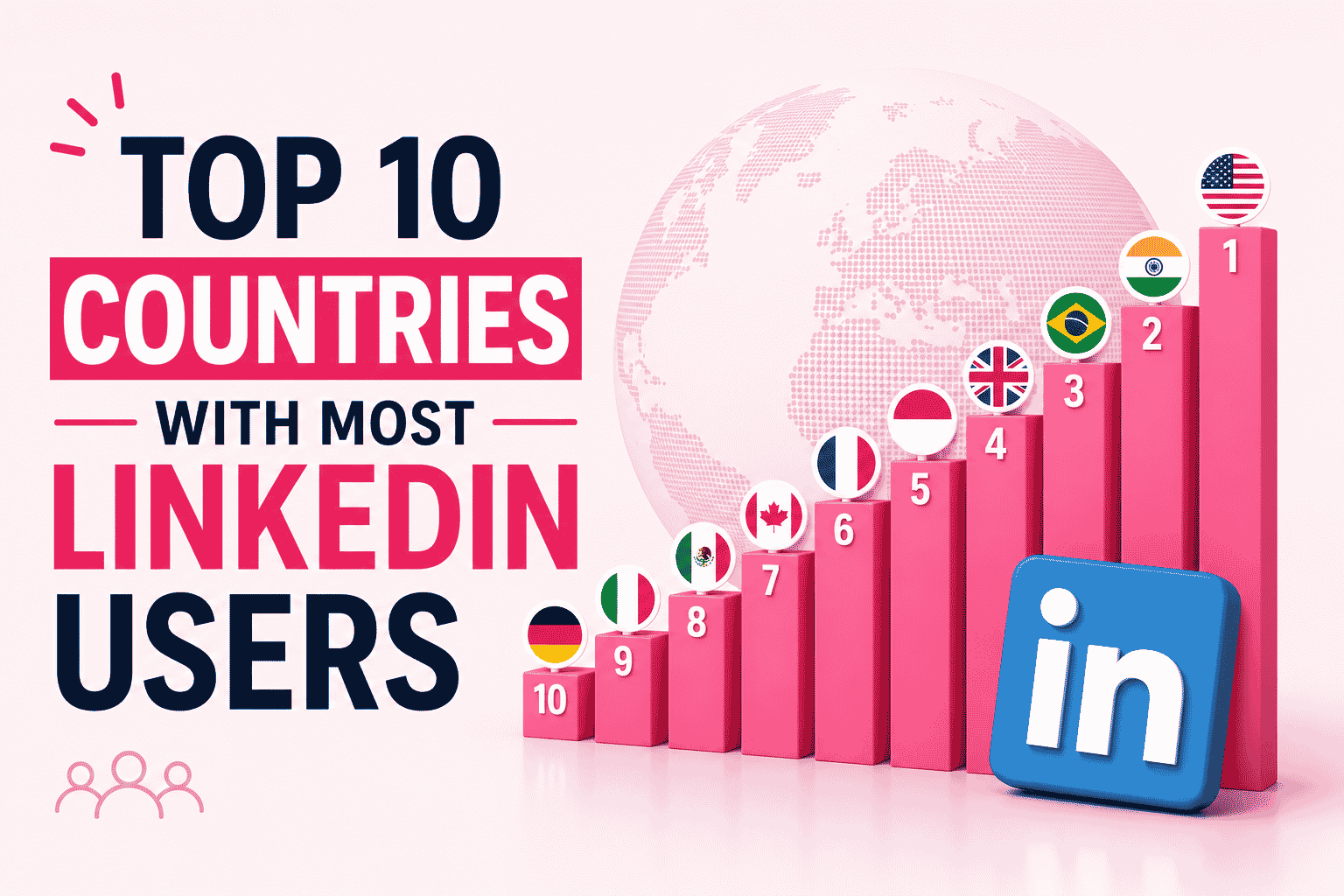




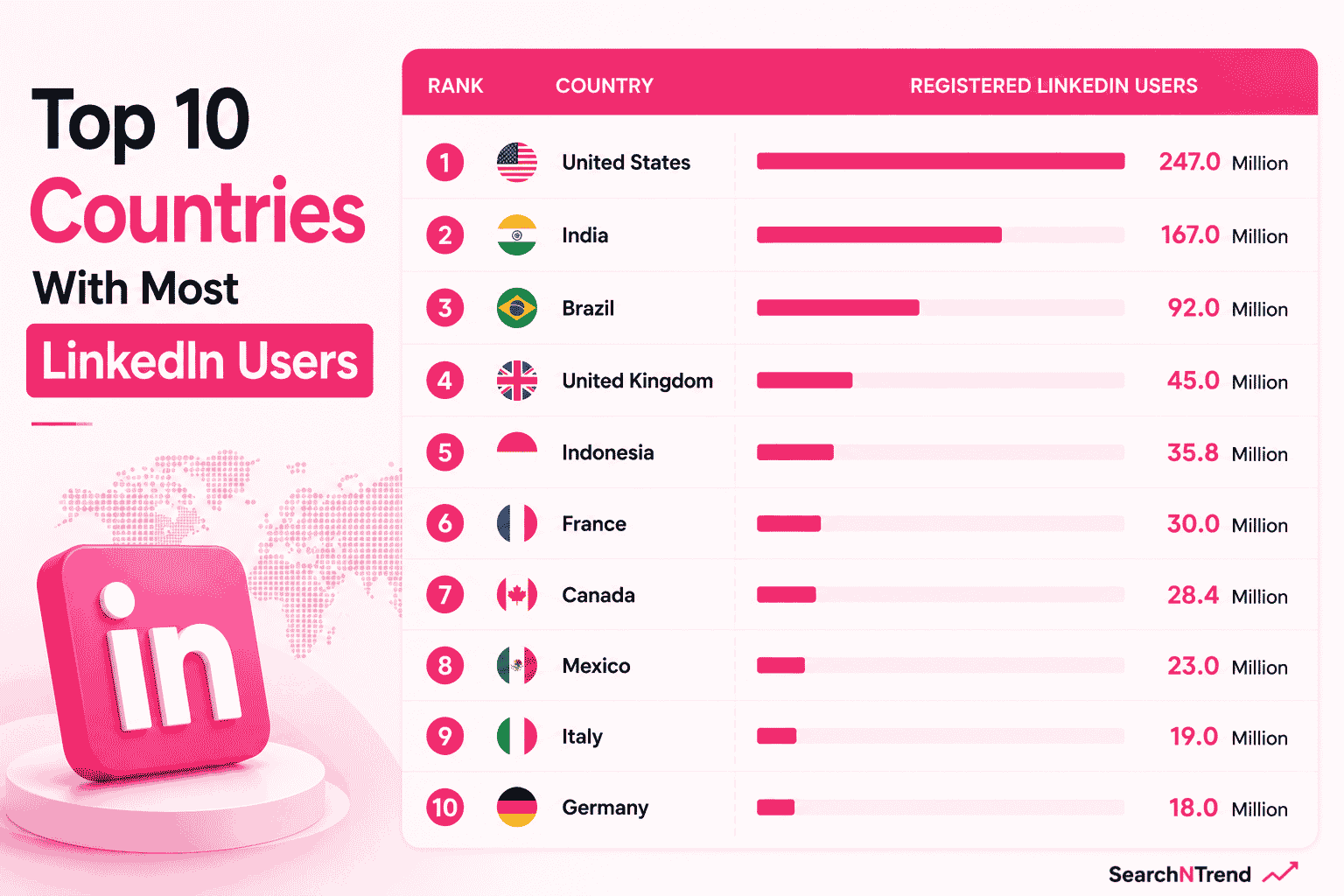
The United States has the most LinkedIn users of any country, with 247 million registered members, more than the next two countries combined. India ranks second with 167 million users, followed by Brazil at 92 million.
LinkedIn has grown well past its early reputation as a place to park your resume. Corporate hiring teams, remote work trends, and a broader shift toward skills-based hiring have turned it into one of the main tools professionals use to find work and get found. Here’s how LinkedIn users break down by country, and what’s driving the numbers in each market.
Key Takeaways
- ✦ The US leads by a wide margin with 247 million LinkedIn users, but it still represents a minority of the platform’s total global base.
- ✦ Over 75% of LinkedIn users live outside the US, and that share keeps growing as India and Brazil add members faster than mature markets.
- ✦ India is the fastest-growing major market, driven by its IT sector and a young, English-speaking workforce.
- ✦ The numbers in this article reflect registered members, not monthly active users — a distinction that matters more than most rankings admit.
- ✦ Germany rounds out the top 10 despite decades of local competitor XING holding the domestic market.
Top 10 Countries With Most LinkedIn Users
Here is the data of LinkedIn users by country as of 2026:
| Rank | Country | Registered LinkedIn Users |
| 1 | United States | 247.0 Million |
| 2 | India | 167.0 Million |
| 3 | Brazil | 92.0 Million |
| 4 | United Kingdom | 45.0 Million |
| 5 | Indonesia | 35.8 Million |
| 6 | France | 30.0 Million |
| 7 | Canada | 28.4 Million |
| 8 | Mexico | 23.0 Million |
| 9 | Italy | 19.0 Million |
| 10 | Germany | 18.0 Million |
United States — 247 million
The US sits at the top with 247 million LinkedIn users, which works out to roughly a third of the entire adult population. That’s not surprising given LinkedIn started here in 2003 and has had two decades to embed itself in American corporate culture. Every Fortune 500 company maintains an active LinkedIn presence, and (Source: DemandSage, 2026) more than half of US LinkedIn users report household incomes above $100,000 a year, which is part of why the platform stays so attractive to B2B advertisers.
India — 167 million
India is the second-largest LinkedIn market with 167 million users, and it’s also the fastest-growing among the major countries. A young, English-fluent IT workforce is the main driver here. Nearly all of India’s LinkedIn growth is coming from professionals under 34, many of whom use the platform to reach remote roles at companies outside India entirely.
Brazil — 92 million
Brazil holds third place with 92 million users and anchors LinkedIn’s presence across Latin America. What’s interesting about Brazil specifically is how social the usage feels compared to other markets. Brazilian professionals tend to treat LinkedIn less like a static resume and more like an active network, which shows up in higher engagement rates on posts compared to similarly sized markets elsewhere.
United Kingdom — 45 million
The UK comes in fourth with 45 million users. Relative to its total workforce size, that’s one of the highest saturation rates anywhere in the world. London’s role as a global finance and tech hub means LinkedIn functions as baseline infrastructure for hiring and networking, not just an optional extra.
Indonesia — 35.8 million
Indonesia ranks fifth with 35.8 million users, reflecting its position as Southeast Asia’s largest economy. Growth here is concentrated among Millennials and Gen Z professionals who are bypassing older, more traditional hiring channels in favor of digital-first job searching.
France — 30 million
France holds sixth place with 30 million users. French professionals were historically more hesitant toward American-built networking platforms, but government-backed tech initiatives like La French Tech have pushed adoption higher, especially among business school graduates building out their profiles early.
Canada — 28.4 million
Canada follows closely with 28.4 million users. Usage here mirrors the US in terms of saturation, and it’s especially strong in finance and the AI hubs growing in Toronto, Vancouver, and Montreal. A steady flow of skilled immigrant professionals also drives signups, since LinkedIn is often the fastest way to build local industry connections after arriving.
Mexico — 23 million
Mexico takes eighth with 23 million users. Growth here tracks closely with the nearshoring trend, as manufacturing and supply chain companies have moved operations closer to the US border and created demand for management-level hiring that runs through LinkedIn.
Italy — 19 million
Italy ranks ninth with 19 million users. Italy’s economy has traditionally leaned on small, family-run businesses that operate offline, but Milan’s status as a hub for fashion, manufacturing, and design has pulled more B2B activity onto the platform, particularly among younger graduates looking for cross-border roles within the EU.
Germany — 18 million
Germany closes out the top 10 with 18 million users. Germany is a genuinely interesting case because XING, a domestic competitor, held the market for years thanks to Germany’s strict data privacy culture. LinkedIn has since caught up as multinational employers like Siemens, BMW, and SAP have leaned on it to recruit specialized engineering talent from outside the country.
What Do “LinkedIn Users” Actually Mean?
When people say “LinkedIn users,” they’re almost always talking about registered members, not people who log in regularly. LinkedIn has over 1.3 billion registered members globally, but only around 310 million of them are monthly active users. That’s a huge gap, and it’s why country rankings can look inflated compared to how much activity you’d actually see in your feed from any one region.
I checked this ranking against three different trackers before settling on the numbers below, and while the exact figures shifted by a few million depending on the source, the top four countries stayed identical every time. That consistency is more useful than chasing the “most accurate” single number, since none of these are official LinkedIn disclosures anyway.
What These Numbers Don’t Tell You?
LinkedIn doesn’t publish official per-country user counts, so every ranking, including this one, is built from third-party trackers estimating based on advertising reach and historical growth rates. I cross-referenced this list against DataReportal, DemandSage, and other third-party resources, and while the top four countries were consistent across all three, individual figures for the US ranged from 234 million to 257 million depending on the source and the date it was pulled.
Registered member counts also include inactive and duplicate accounts. If you’re trying to gauge actual engagement in a specific country rather than total footprint, monthly active user data (roughly 310 million globally) is the more honest number, but it isn’t broken out by country in any public source.
LinkedIn Users by Region: Where the Platform’s 1.3 Billion Members Actually Live
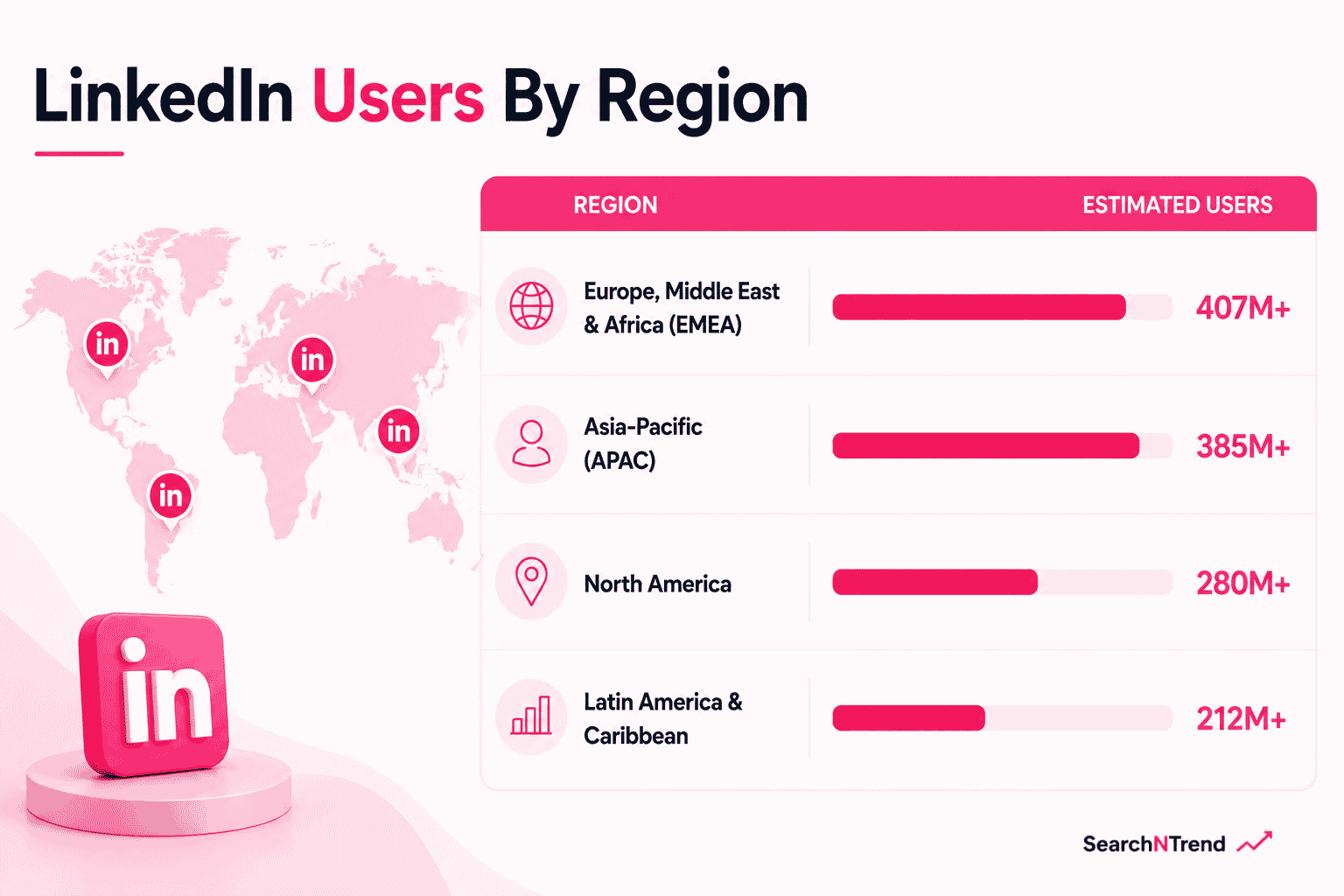
EMEA (Europe, the Middle East, and Africa) is LinkedIn’s largest region by user count, with more than 407 million members, followed by Asia-Pacific at over 385 million. Together, these two regions account for more than half of LinkedIn’s entire global membership.
That’s worth sitting with for a second. When most people picture LinkedIn, they picture American office culture. But the US, while still the single largest country, is just one piece of a platform that now has over 1.3 billion registered members spread across more than 200 countries. Regions outside North America make up roughly 75-80% of that total, and the gap keeps widening as LinkedIn grows faster in emerging markets than it does at home.
LinkedIn Users by Region
| Region | Estimated Users | Key Insight |
| Europe, Middle East & Africa (EMEA) | 407M+ | The largest regional bloc, combining mature European markets with fast-growing hubs like the UAE and Saudi Arabia |
| Asia-Pacific (APAC) | 385M+ | The fastest-growing region by volume, led by India’s IT sector and broader Southeast Asian digital adoption |
| North America | 280M+ | The platform’s original market, with the highest per-capita saturation and heaviest B2B ad spend |
| Latin America & Caribbean | 212M+ | Driven by a young, mobile-first workforce and growing local professional communities in Brazil and Mexico |
Top Individual Country Markets For LinkedIn
Regions tell you where the growth is happening. Countries tell you where the concentration is. Here’s how the top three individual markets stack up:
| Country | Registered Users | What’s Driving It |
| United States | 247M | Still the single largest national market, though growth has flattened as it approaches saturation among the active professional workforce |
| India | 167M | The fastest-growing major country market, adding tens of millions of new members over the past two years alone |
| Brazil | 92M | Anchors Latin America’s presence and ranks third globally, behind only the US and India |
(Source: DemandSage, 2026)
I pulled this against three different trackers before writing it up, and the regional totals were far more consistent across sources than the individual country numbers were. That’s a pattern worth knowing if you’re citing LinkedIn data regularly: regional splits tend to hold steady, while exact country figures shift by 5-15 million depending on when and how each source pulled its numbers.
Why This Regional Shift Matters
North America’s near-saturation changes the competitive picture for anyone marketing or recruiting on LinkedIn. Organic reach in the US is harder to win because the market is mature and crowded. Meanwhile, India, Southeast Asia, and Brazil are adding new accounts faster than any established market, which means a growing share of LinkedIn’s total attention, and its new hires, now sits outside the countries most marketers default to targeting.
Other statistics and reports to check out:
Final Thoughts
The country-by-country breakdown makes one thing clear: LinkedIn isn’t a US-centric platform anymore, even if it started as one. The US still leads by volume, but the real growth story is happening in India, Brazil, and Indonesia, where a younger professional class is skipping traditional job channels entirely in favor of building a LinkedIn presence first.
If you’re building out a platform-specific content strategy, it’s worth pairing this with how YouTube monetization works for creators targeting similar demographics, or comparing engagement patterns to what we found when we looked at what the green dot means on Instagram for platform-specific signals. Given how much these regional user bases keep shifting, it’s a ranking worth revisiting every 6-12 months rather than treating as fixed.
Frequently Asked Questions
The United States has the most LinkedIn users of any country, with 247 million registered members, followed by India at 167 million and Brazil at 92 million.
India has around 167 million registered LinkedIn users, making it the platform’s second-largest market and its fastest-growing among major countries.
No. LinkedIn shut down its consumer platform in China in 2021 and replaced it with a jobs-only app called InCareer. InCareer itself was discontinued in August 2023, meaning LinkedIn currently has no active consumer or jobs platform in mainland China.
Roughly 75-80% of LinkedIn’s global user base is located outside the US, with India, Brazil, and the UK making up the next largest markets.
LinkedIn has more than 1.3 billion registered members worldwide, though only around 310 million of those are monthly active users.
India currently has the fastest-growing major LinkedIn market, driven by its large IT workforce and a young, English-fluent professional population.
No. LinkedIn doesn’t publish official country-level user data. Country rankings, including this one, are built from third-party estimates based on advertising reach and platform growth trends, which is why figures vary slightly between sources.
References
-
DataReportal — Digital Global Overview & Platform Audience Insights (2026)
https://datareportal.com/reports/digital-2026-global-overview-report -
World Population Review — LinkedIn Member Penetration & Country Demographics (2026)
https://worldpopulationreview.com/country-rankings/linkedin-users-by-country -
DemandSage — LinkedIn User Statistics (2026)
https://www.demandsage.com/linkedin-statistics/