
YouTube monetization is the process of earning money from your YouTube content through the YouTube Partner Program (YPP). Once accepted, you can earn from ads, channel memberships, Super Chats, YouTube Shopping, and more — all directly through the platform.
If you’ve ever wondered how creators turn views into income, this guide breaks it all down. No fluff, just what you actually need to know.
YouTube Monetization Key Takeaways
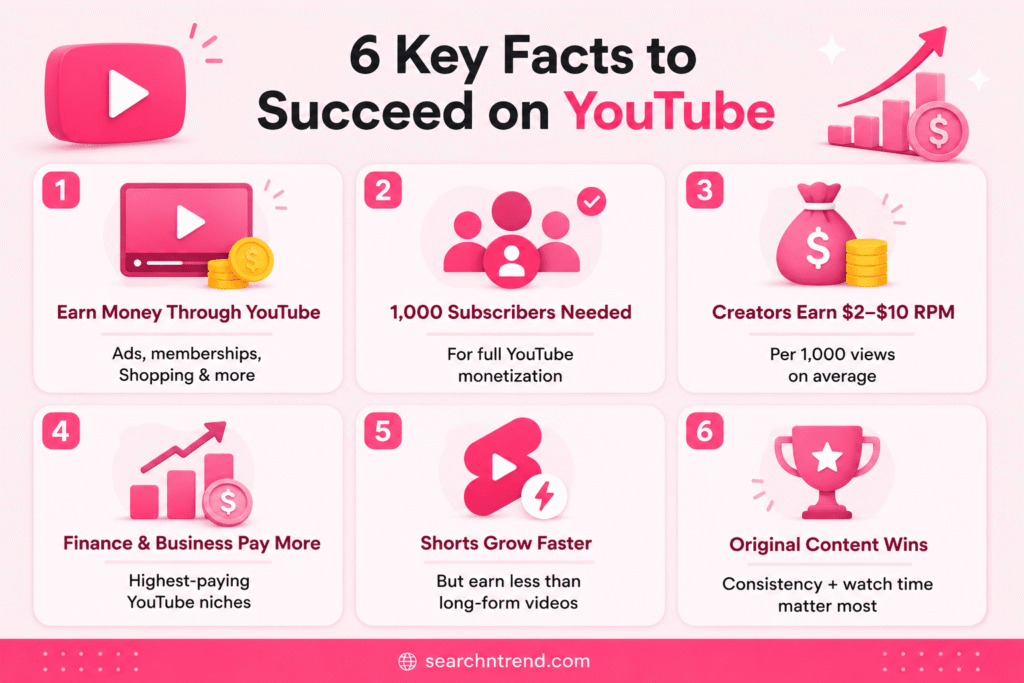
- YouTube monetization allows creators to earn through ads, memberships, Super Chats, Shopping, and YouTube Premium.
- Full YouTube monetization in 2026 requires 1,000 subscribers and 4,000 watch hours or 10 million Shorts views.
- Most creators earn between $2–$10 RPM per 1,000 views, depending on niche and audience location.
- Finance, business, and real estate channels typically earn the highest YouTube ad revenue.
- YouTube Shorts help grow channels faster, but earn significantly less than long-form videos.
- Original content, strong watch time, and consistent uploads are essential for YouTube monetization approval.
What is YouTube Monetization?
At its core, YouTube monetization means YouTube pays you a share of the revenue your content generates.
The primary way this works: advertisers pay YouTube to show ads on videos. YouTube takes 45% of that revenue and gives you the remaining 55%.
But ads are just one piece of the puzzle. Once you’re in the YouTube Partner Program, you unlock multiple income streams, which I’ll cover in detail below.
Here’s the big picture in numbers:
- YouTube generated $40.4 billion in ad revenue in 2025 — an 11.7% year-over-year increase.
- That means roughly $22 billion was paid out to creators in ad revenue alone in a single year.
- YouTube’s total revenue (including subscriptions) crossed $60 billion in 2025, making it larger than Netflix ($45.18 billion).
The opportunity is real. But to access it, you need to meet specific requirements first.
Source: AutoFaceless
YouTube Partner Program (YPP) Requirements in 2026
YouTube doesn’t open monetization to everyone immediately. You need to qualify for the YouTube Partner Program (YPP), and in 2026, there are now two tiers.
Tier 1: Early Access (Fan Funding Only)
This tier was introduced to give smaller creators a head start. You won’t earn ad revenue yet, but you can access fan funding features like Super Thanks, channel memberships, and YouTube Shopping.
Requirements:
- 500 subscribers
- 3 valid public video uploads in the last 90 days
- 3,000 valid public watch hours in the past 12 months OR 3 million valid Shorts views in the last 90 days
- No active Community Guidelines strikes
- 2-Step Verification is enabled on your Google account
- Linked AdSense account
Tier 2: Full Monetization (Ad Revenue + Everything Else)
This is the full package. To unlock ad revenue, you need:
- 1,000 subscribers
- 4,000 valid public watch hours in the past 12 months OR 10 million valid Shorts views in the past 90 days
- No active Community Guidelines strikes
- 2-Step Verification enabled
- Linked AdSense account
- Residence in a YPP-eligible country
Here’s a quick side-by-side comparison:
| Requirement | Early Access (Tier 1) | Full Monetization (Tier 2) |
| Subscribers | 500 | 1,000 |
| Watch Hours (12 months) | 3,000 | 4,000 |
| Shorts Views (90 days) | 3 million | 10 million |
| Ad Revenue | ❌ | ✅ |
| Channel Memberships | ✅ | ✅ |
| Super Chat & Stickers | ✅ | ✅ |
| YouTube Shopping | ✅ | ✅ |
One important note: Shorts watch time does NOT count toward your 4,000 long-form watch hours. They are tracked separately.
How Does YouTube Monetization Actually Work?
Once you’re accepted into YPP, here’s what happens behind the scenes.
1. Ads Run on Your Videos
Advertisers bid to show ads on your content through Google’s ad auction system. The more valuable your audience is to advertisers, the more they bid — and the more you earn.
Types of ads on YouTube:
- Pre-roll ads (before the video)
- Mid-roll ads (during the video — only available on videos 8+ minutes long)
- Display ads (sidebar banners)
- Non-skippable ads
- Bumper ads (6-second non-skippable)
Videos over 8 minutes can include multiple mid-roll ads, which significantly increases earning potential per video.
2. CPM vs. RPM — Know the Difference
This is where most creators get confused. Let me make it simple.
CPM (Cost Per Mille) = what advertisers pay YouTube per 1,000 ad impressions. This is NOT what you earn.
RPM (Revenue Per Mille) = what YOU actually earn per 1,000 views after YouTube takes its 45% cut. This is your real income metric.
Example: If your CPM is $10, your RPM will typically be around $5–$6 after YouTube’s share and accounting for views where no ad ran.
Average CPM in 2026: ~$3.50 — but this varies massively by niche, audience location, and content type.
3. How Much Can You Actually Earn on YouTube?
Here’s where it gets interesting, and honestly, where most people are surprised.
Average creator earnings per 1,000 views: $2–$10, with $3–$5 being most common globally.
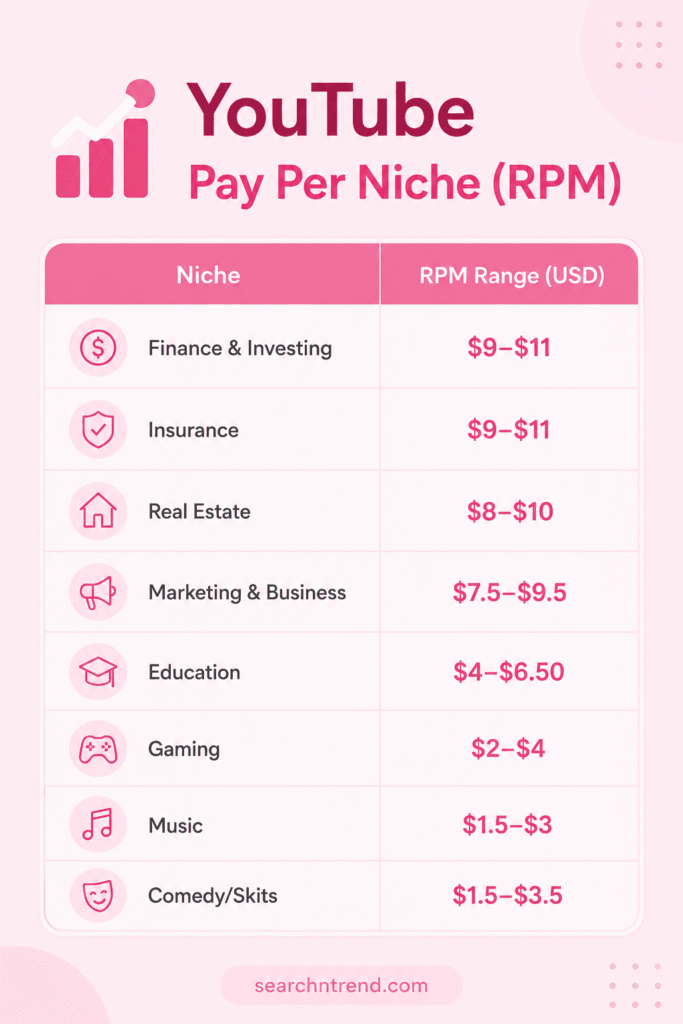
But niche makes a massive difference. Look at this breakdown of YouTube RPM by niche:
| Niche | RPM Range |
| Finance & Investing | $9–$11 |
| Insurance | $9–$11 |
| Real Estate | $8–$10 |
| Marketing & Business | $7.5–$9.5 |
| Education | $4–$6.50 |
| Gaming | $2–$4 |
| Music | $1.5–$3 |
| Comedy/Skits | $1.5–$3.5 |
A real example: Personal finance creator Josh Mayo reported earning $29.30 per 1,000 views after focusing on high-value topics like credit cards and investing.
That’s the power of niche selection.
Geography matters too. Australia tops the charts with an average CPM of $36.21, while the US averages around $32. If your audience is primarily in lower-income markets, your RPM will reflect that.
How to Make Money on YouTube 2026 (All Ways Listed)
Ad revenue is the most talked-about income stream — but it’s far from the only one.
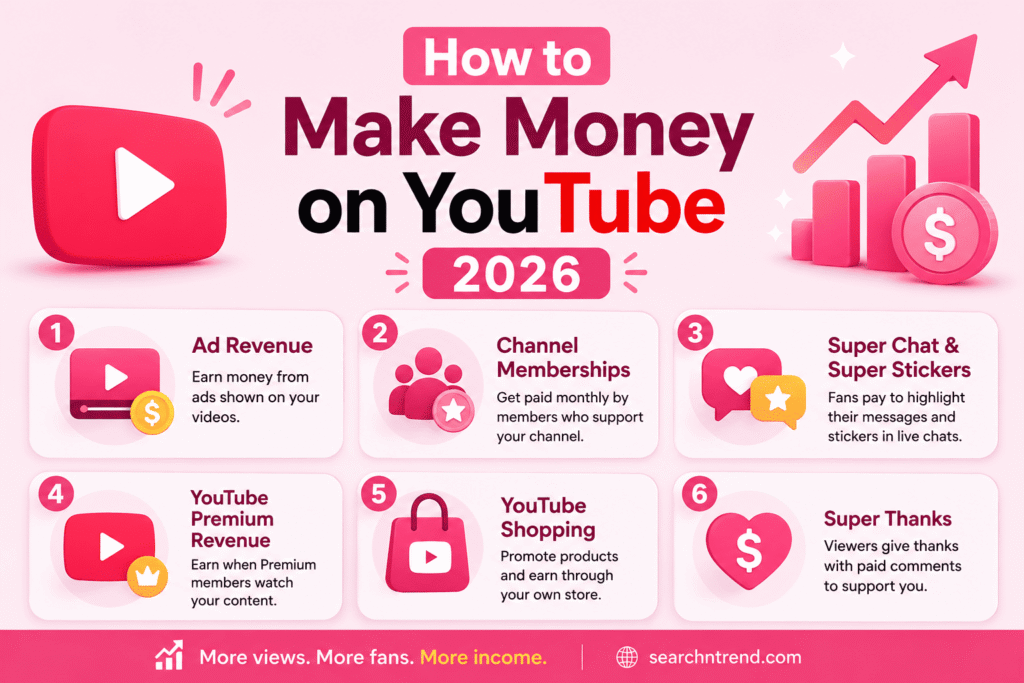
Ad Revenue
The baseline. You earn 55% of ad revenue generated on your videos. Simple, passive, and scales with views.
Channel Memberships
Viewers pay a monthly fee (starting at $0.99/month) to get exclusive perks — badges, emojis, members-only content. YouTube takes 30% of membership revenue.
You need at least 500 subscribers to unlock this feature.
Super Chat & Super Stickers
During live streams, viewers can pay to have their message highlighted. This feature grew 45% year-over-year in 2026 as live streaming became a primary revenue driver for creators.
YouTube Premium Revenue
When a YouTube Premium subscriber watches your content, you get a share of their subscription fee based on watch time. It’s not huge, but it adds up passively.
YouTube Shopping
Link your store directly to your videos and let viewers shop without leaving YouTube. This is growing fast — YouTube Shopping affiliate revenue increased 52% in 2026.
Super Thanks
Viewers can tip you on any video (not just live streams) with a one-time payment. It’s YouTube’s version of a tip jar.
Do you know one country dominates with 467 million active viewers! Find details in Top 10 Countries with the Most YouTube Users.
YouTube Shorts Monetization — What’s Different?
Shorts have their own monetization rules, and they work very differently from long-form videos.
The honest truth: Shorts earn significantly less per view than regular videos.
- Average Shorts payout: $0.03–$0.08 per 1,000 views
- Average long-form payout: $3.50–$6.15 per 1,000 views
That’s roughly 50–70x less per view.
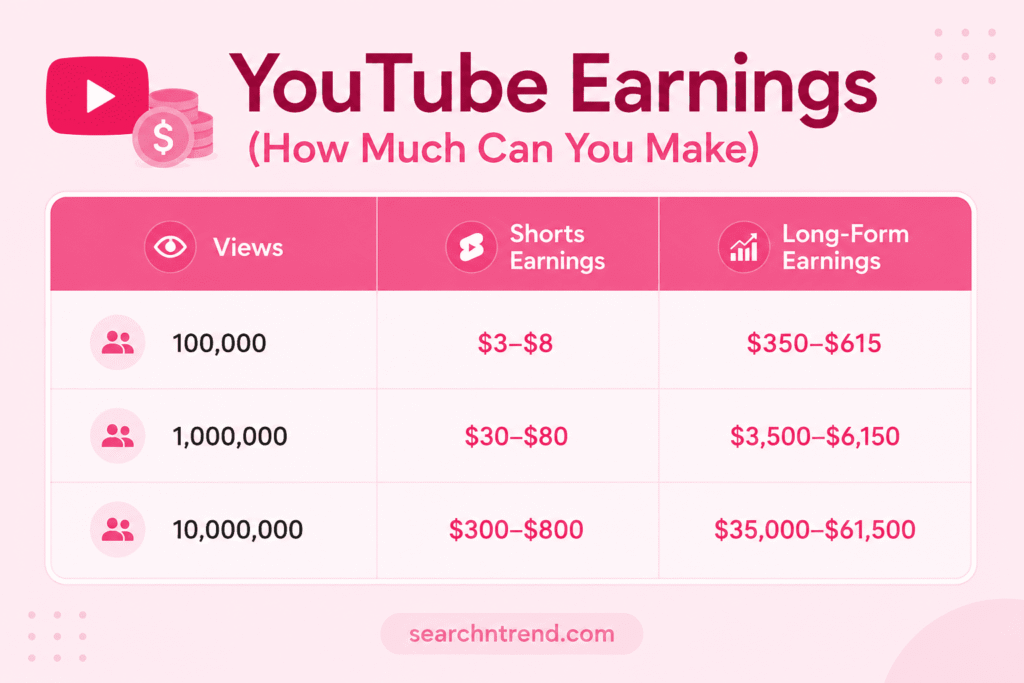
To put it in perspective:
| Views | Shorts Earnings | Long-Form Earnings |
| 100,000 | $3–$8 | $350–$615 |
| 1,000,000 | $30–$80 | $3,500–$6,150 |
| 10,000,000 | $300–$800 | $35,000–$61,500 |
So why bother with Shorts at all? Because they drive discovery. Creators who post 3–5 Shorts weekly alongside long-form content see 23% higher overall revenue than those focusing exclusively on either format.
Use Shorts to grow. Use long-form to monetize. That’s the smart play.
How to Apply for YouTube Monetization — Step by Step
Ready to apply? Here’s exactly what to do.
- Go to YouTube Studio (studio.youtube.com)
- Click “Earn” in the left sidebar
- Review and accept the YouTube Partner Program terms
- Set up a Google AdSense account — this is how YouTube pays you
- Wait for YouTube to review your channel
How long does approval take?
Typically up to 30 days, though some channels are approved faster. If rejected, you can reapply after addressing the issues. Repeated rejections lead to longer waiting periods.
Common reasons for rejection:
- Reused or low-effort content
- Community Guidelines violations
- Insufficient original content
- Misleading thumbnails or titles
What YouTube Looks For Before Approving You
Meeting the numbers is necessary, but not sufficient. YouTube reviews your entire channel before approval.
They check:
- Whether your content is original and authentic
- Whether your videos follow advertiser-friendly content guidelines
- Whether your channel has a consistent focus
- Whether your content could be replicated at scale without effort
In 2026, YouTube is particularly strict about AI-generated content. If your videos are AI-scripted with stock footage and no original value, expect rejection. YouTube updated its “repetitious content” policy in July 2025 to explicitly include mass-produced or template-based content.
The takeaway: Be a creator, not a copier. YouTube rewards originality.
How to Speed Up Getting Monetized on YouTube
Getting to 1,000 subscribers and 4,000 watch hours takes time, but these strategies genuinely help.
- Post consistently.
Channels that upload at least once a week grow significantly faster than sporadic uploaders.
- Focus on watch time, not just views.
YouTube’s algorithm prioritizes content that keeps people watching. A video with 10,000 views and 70% retention beats one with 50,000 views and 20% retention every time.
- Make videos longer than 8 minutes
once monetized, this unlocks mid-roll ads and meaningfully increases your revenue per video.
- Pick a niche with high CPM potential
If you’re open to topics, finance, education, marketing, and technology consistently command the highest ad rates.
- Use Shorts strategically.
Post Shorts to attract new viewers, then convert them into long-form subscribers, where the real money is.
Final Thoughts
YouTube monetization isn’t a lottery. It’s a system — and once you understand how it works, you can build toward it intentionally.
The platform paid out roughly $22 billion to creators in 2025. That money goes somewhere. It goes to channels that post consistently, create original content, and understand what advertisers actually want.
Start with the basics: meet the requirements, apply for YPP, and then diversify beyond ads into memberships, Super Chat, and YouTube Shopping. The creators earning $50,000–$500,000+ annually aren’t relying on ads alone — 41% of their revenue comes from non-ad sources.
Pick your niche wisely, post consistently, and treat your channel like a business from day one.
Frequently Asked Questions
It varies widely. For most creators, reaching 1,000 subscribers and 4,000 watch hours takes 6–12 months with consistent posting.
No. YouTube Shorts watch time is tracked separately. For long-form monetization, you need 4,000 hours from regular public videos only.
On average, $2–$10 per 1,000 views, with most creators earning $3–$5. Finance and business content can earn $9–$11 RPM or more.
YouTube will tell you why. Fix the issues, then reapply. Note that repeated rejections result in longer waiting periods before you can apply again.
Yes — but only for fan funding features (Super Chat, memberships, Shopping). Full ad revenue requires 1,000 subscribers and 4,000 watch hours.